Why Do We Have Wisdom Teeth? Their Purpose Then and Now
Wisdom teeth helped our ancestors chew a tough diet; smaller modern jaws explain why they so often cause trouble today.
Edited and fact-checked by our editorial team.
Why do we have wisdom teeth? They are a leftover from ancestors who needed extra molars to grind raw plants, nuts and tough meat, and most health providers now regard them as vestigial: useful once, largely unnecessary today.
That answer explains a lot about why wisdom teeth are so often troublesome. A set of teeth suited to a bigger jaw and a tougher diet now tries to fit into a smaller mouth. Below, we look at what wisdom teeth were for, what changed, whether they still do anything useful, and what that means when you are deciding with your dentist whether to keep them.
What are wisdom teeth?
Wisdom teeth are the third molars, the last adult teeth to come in. Cleveland Clinic explains that people can have up to four, one behind the second molar in each corner of the mouth, and that they usually come through between 17 and 25. They look much like the other molars, usually with two or three roots, though the roots can be fused, curved or splayed.
What were wisdom teeth originally for?
Molars are grinding teeth. Cleveland Clinic notes that our ancestors ate raw plants, hard nuts and tough meats, and wisdom teeth helped them grind this food so it could be digested. An extra row of broad chewing surfaces at the back of a larger jaw made practical sense when food was coarse and needed a lot of chewing.
Why are wisdom teeth less useful now?
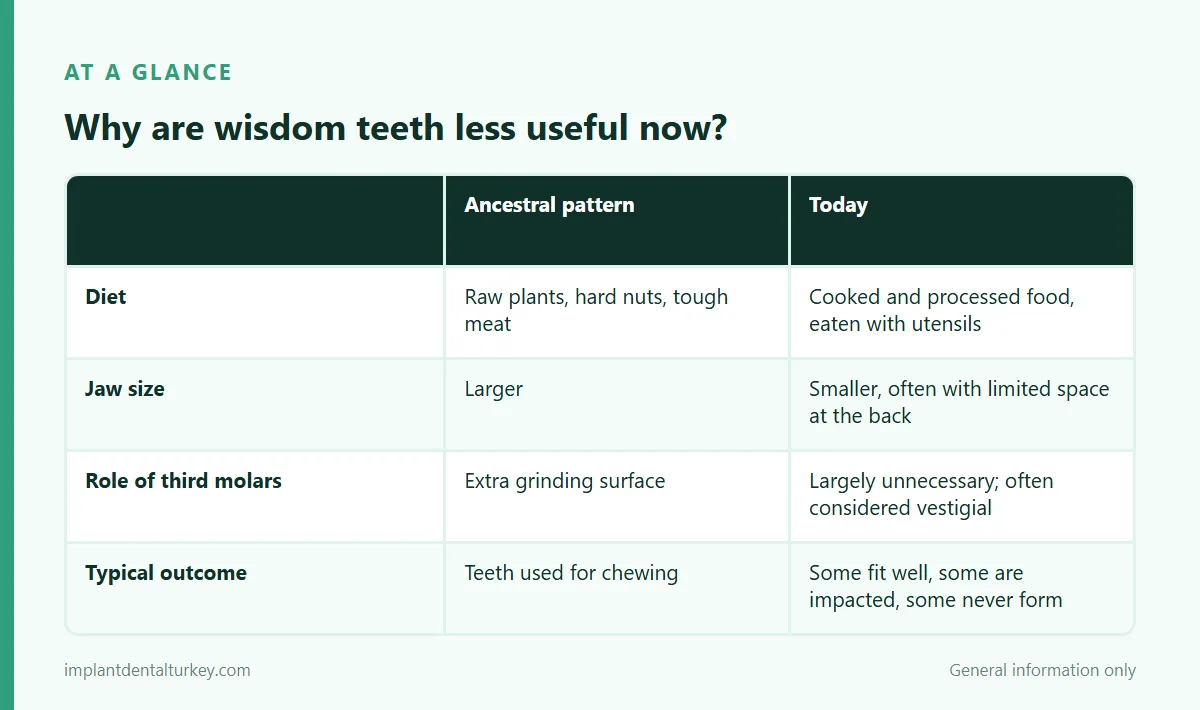
Two things changed. First, the way we prepare food. Cleveland Clinic points out that modern food preparation and eating utensils have made the extra grinding power largely unnecessary. Second, the size of our jaws. Over a long period, modern diets have been linked with smaller jaws, so many people no longer have room for a full set of third molars.
A 2020 study published in PeerJ describes a broader evolutionary trend in humans towards fewer molars and notes that facial size has also reduced over the course of human evolution. The authors’ data suggest that the number of teeth that form is linked with facial size in people today. That helps explain why wisdom teeth vary so much from person to person.
| Ancestral pattern | Today | |
|---|---|---|
| Diet | Raw plants, hard nuts, tough meat | Cooked and processed food, eaten with utensils |
| Jaw size | Larger | Smaller, often with limited space at the back |
| Role of third molars | Extra grinding surface | Largely unnecessary; often considered vestigial |
| Typical outcome | Teeth used for chewing | Some fit well, some are impacted, some never form |
Do wisdom teeth still have any purpose?
They can. Cleveland Clinic says that when wisdom teeth come through in the proper position, they can support the back of the mouth and help preserve jawbone. A wisdom tooth that has come through in line with the other teeth and can be kept clean may cause no trouble at all.
Even so, Cleveland Clinic states that most healthcare providers consider wisdom teeth vestigial, meaning they once had a purpose but largely no longer do. Both views can be true at the same time: they are not essential, yet a healthy, well-positioned one does not need to be removed for the sake of it.
Why the mismatch causes problems
When there is not enough room, a wisdom tooth may be blocked by the tooth in front of it or only partly break through the gum. Cleveland Clinic calls a tooth trapped in the gum or bone “impacted”. The NHS describes the problems that can follow:
- pain and swelling at the back of the mouth
- infection of the gum flap over a partly erupted tooth (pericoronitis)
- trapped food, leading to tooth decay in the wisdom tooth or its neighbour
- gum disease
- cysts or a dental abscess
Cleveland Clinic also lists damage to neighbouring teeth, and cysts or tumours, among the possible complications of impacted or poorly erupted wisdom teeth. Because their back surfaces are hard to reach, it recommends brushing regularly and flossing daily, with extra attention to these teeth.
Is everyone born with wisdom teeth?
Not everyone develops them. The PeerJ paper cites a worldwide average of about 22.6% of people missing at least one third molar, with variation between populations. The researchers found missing wisdom teeth were far more common among people who were also missing other teeth, which suggests that the same developmental factors are involved. Cleveland Clinic describes having none, some or all four as a normal variation.
What does this mean for you today?
Knowing why we have wisdom teeth does not decide whether yours should stay. The NHS says that if a wisdom tooth is not causing problems, it is usually left in place and monitored at routine check-ups. Removal is generally considered when a tooth has not come through properly and is causing trouble. Cleveland Clinic similarly says no action may be needed if they line up with the other teeth and cause no problems.
If you develop pain, swelling or a bad taste at the back of your mouth, see your dentist. Swelling that spreads into your face or neck, or difficulty swallowing or breathing, needs urgent attention. Our guide to urgent dental care in New Zealand explains where to go, and the wisdom tooth removal guide covers the procedure and recovery.
Frequently asked questions
Are wisdom teeth useless?
Not entirely. Most providers consider them vestigial, but Cleveland Clinic notes that well-positioned wisdom teeth can support the back of the mouth and help preserve jawbone.
Are humans evolving to lose wisdom teeth?
Researchers describe an evolutionary trend towards fewer molars and smaller faces, and missing wisdom teeth are already common. How this will change in future is not something the evidence can predict precisely.
Why do wisdom teeth come in so late?
They are simply the last teeth in the adult sequence, usually appearing between about 17 and 25, according to Cleveland Clinic.
If my wisdom teeth are fine, should I keep them?
The NHS says healthy wisdom teeth that cause no problems are usually left in place and checked at regular appointments. Ask your dentist about your own situation.
Sources
- Cleveland Clinic, Wisdom Teeth: Function and Location
- NHS, Wisdom tooth removal
- PeerJ (via PubMed Central), Third molar agenesis in modern humans with and without agenesis of other teeth
This article is general information and does not replace advice from your own dentist.