Does Everyone Have Wisdom Teeth? How Many You Get and Why Some Are Missing
Not everyone develops wisdom teeth; here is how many you can have, how common it is to be missing them and when they cause problems.
Edited and fact-checked by our editorial team.

Does everyone have wisdom teeth? No. Many people develop all four, but a sizeable minority are missing one or more, and Cleveland Clinic describes having none, some or all of them as normal variation.
Wisdom teeth are the third molars, the last adult teeth to form and come through. Because they arrive so late and so unpredictably, they cause a lot of questions: how many you should have, why a friend never got any, and whether a tooth you cannot see is still lurking in the jaw. This article explains what the research and health services say.
How many wisdom teeth can you have?
Most people can have up to four wisdom teeth, one at the very back of each quarter of the mouth: upper left, upper right, lower left and lower right. They sit directly behind the second molars and look much like other molars, usually with two or three roots, according to Cleveland Clinic.
Cleveland Clinic says they usually come through between the ages of 17 and 25. The NHS gives a similar picture, describing them as coming through in the late teens or early twenties.
How common is it to be missing wisdom teeth?
Missing third molars are common enough that dental researchers usually study them separately from other missing teeth. A 2020 study in the journal PeerJ cites a large review that put the worldwide average rate of third molar agenesis (wisdom teeth that never form) at 22.6%, and 21.6% for people of European background. The same paper notes that Asian populations show the highest rates.
In other words, roughly one in five people worldwide is missing at least one wisdom tooth. Rates vary between populations and between studies, so treat this as a broad average rather than a precise figure for New Zealand.
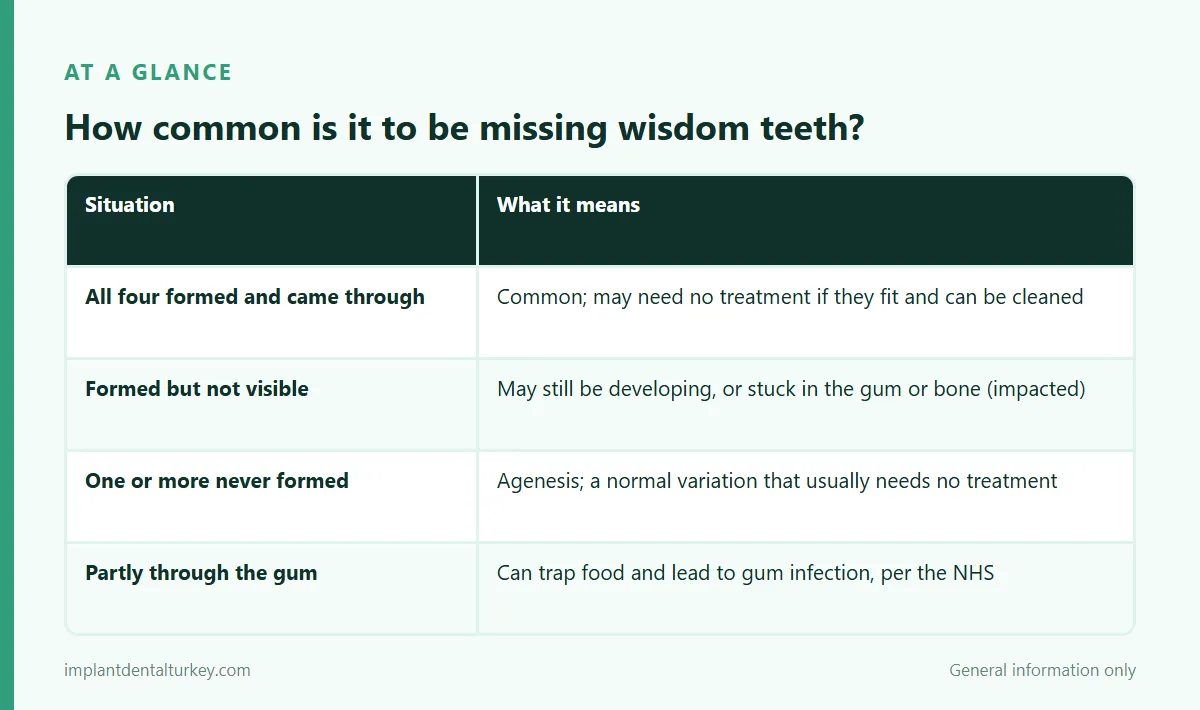
| Situation | What it means |
|---|---|
| All four formed and came through | Common; may need no treatment if they fit and can be cleaned |
| Formed but not visible | May still be developing, or stuck in the gum or bone (impacted) |
| One or more never formed | Agenesis; a normal variation that usually needs no treatment |
| Partly through the gum | Can trap food and lead to gum infection, per the NHS |
Why do some people never get wisdom teeth?
Cleveland Clinic links the story to changes in diet over a very long period. Our ancestors chewed raw plants, hard nuts and tough meat, and an extra set of grinding teeth was useful. As food preparation changed, jaws became smaller over time, and many people today simply lack room for these teeth.
The PeerJ researchers describe an evolutionary trend in humans towards fewer molars and smaller faces, and their own data suggest the number of teeth that form is associated with facial size. They also found that missing wisdom teeth were much more common in people who were missing other teeth too: 50.8% compared with 20.5% in matched controls. That points to a shared developmental and genetic influence, although the full picture is still being studied.
Not seeing them does not mean they are not there
A wisdom tooth can form in the jaw but never fully break through the gum. Cleveland Clinic calls a tooth that is stuck in the gums or jawbone “impacted”. The NHS explains that a wisdom tooth may be blocked by another tooth or partly covered by gum when there is not enough space.
So if you are in your twenties and have no visible wisdom teeth, there are two broad possibilities: they never formed, or they are present but hidden. Your dentist checks wisdom teeth during routine examinations and can tell you which applies to you.
Do wisdom teeth always cause problems?
No. Cleveland Clinic says that if they come through in the right position and line up with the other teeth, no treatment may be needed. The NHS says a wisdom tooth that is not causing problems is usually left in place and monitored at routine check-ups.
When there is too little room, or a tooth comes through at an angle or only partly, problems can follow. The NHS lists:
- pain and swelling
- gum infection around a partly erupted tooth (pericoronitis)
- food getting trapped, leading to tooth decay
- gum disease
- a fluid-filled cyst
- a dental abscess
Cleveland Clinic adds that impacted or poorly positioned wisdom teeth can damage the neighbouring teeth. If you have pain, swelling or a bad taste around the back of your mouth, book in with your dentist. Swelling that spreads into your face or makes swallowing or breathing difficult needs urgent care.
If removal is recommended, our wisdom tooth removal guide for New Zealand covers what to expect and how recovery usually goes.
Looking after the wisdom teeth you do have
Because they sit so far back, wisdom teeth are hard to reach. Cleveland Clinic recommends regular brushing and daily flossing, paying particular attention to the back surfaces of these teeth. Your dentist or hygienist can show you how to angle the brush and floss so you reach them properly.
If cost is a barrier to urgent treatment such as an extraction, Work and Income offers a grant of up to $1,000 (Work and Income, checked October 2026) in any 52-week period for immediate and essential dental treatment, which includes extractions and treating infections. Eligibility depends on income, assets and residency, and you do not need to be on a benefit to apply.
Frequently asked questions
Is it normal to have only two wisdom teeth?
Yes. Cleveland Clinic describes having none, some or all four as normal variation.
Can wisdom teeth come through after 25?
Most come through between about 17 and 25, but the NHS notes that problems with wisdom teeth can happen at any age. If you notice new pain at the back of your mouth, have it checked.
Is having no wisdom teeth a sign of a health problem?
On its own, no. Missing wisdom teeth are common. If other adult teeth are also missing, your dentist may discuss this with you, as the two often occur together.
Should I have healthy wisdom teeth removed just in case?
The NHS says wisdom teeth that are not causing problems are usually left in place and monitored. Your dentist can explain what suits your situation.
Sources
- Cleveland Clinic, Wisdom Teeth: Function and Location
- NHS, Wisdom tooth removal
- PeerJ (via PubMed Central), Third molar agenesis in modern humans with and without agenesis of other teeth
- Work and Income, Dental treatment
This article is general information and does not replace advice from your own dentist.