Adjacent Teeth: How Gap Treatments Affect Your Neighbouring Teeth
Why the teeth next to a gap often decide between a bridge and an implant.
Edited and fact-checked by our editorial team.
Adjacent teeth are the teeth either side of a gap. They matter when you replace a missing tooth: a traditional bridge needs at least one adjacent tooth on each side shaved down for crowns, while an implant stands on its own without changing the neighbouring teeth.
When you’re weighing up how to fill a gap, the health of the teeth next to it is often the deciding factor. This guide explains how each option affects adjacent teeth and what to ask your dentist.
How does a bridge affect adjacent teeth?
Cleveland Clinic notes that, unlike implants, bridges require shaving at least one tooth on either side of the gap. Those adjacent teeth are crowned and support the false tooth between them. Cork University Dental School and Hospital makes the same point from the other direction: implants are useful where bridging the gap would otherwise mean cutting down and crowning healthy teeth.
So a useful first question is what state the adjacent teeth are in: whether they are healthy and untouched, or already heavily restored. Your dentist can explain how that changes the trade-off between a bridge and an implant.
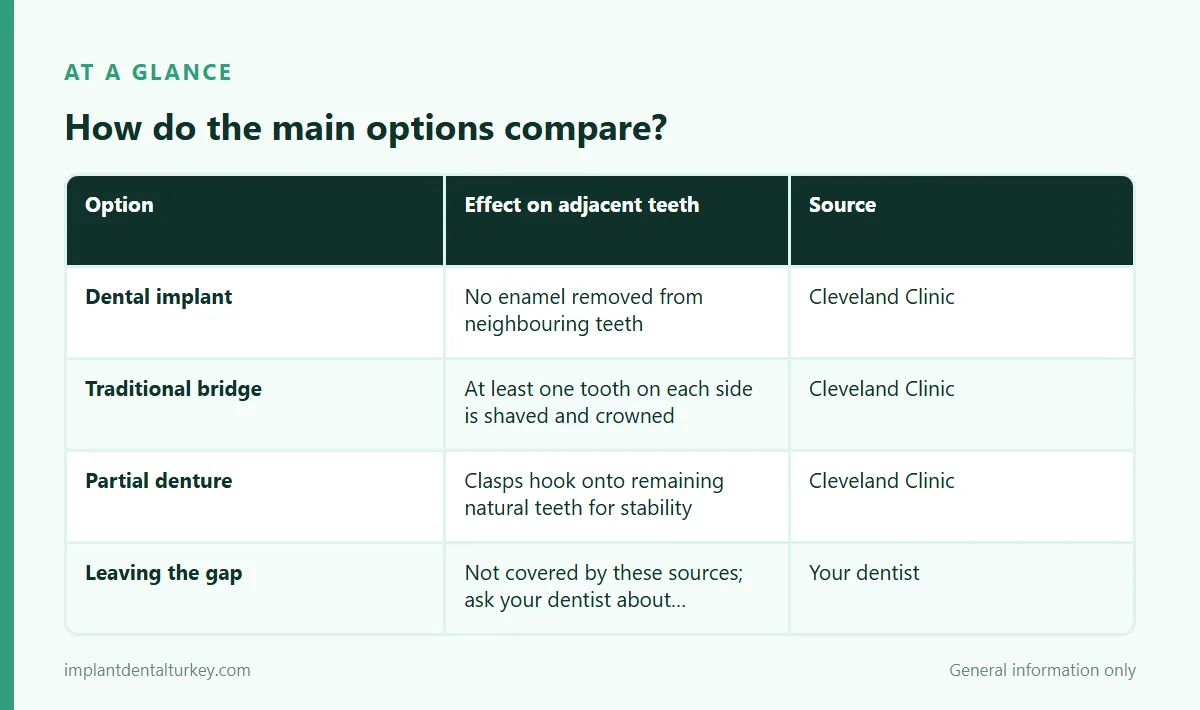
How do the main options compare?
| Option | Effect on adjacent teeth | Source |
|---|---|---|
| Dental implant | No enamel removed from neighbouring teeth | Cleveland Clinic |
| Traditional bridge | At least one tooth on each side is shaved and crowned | Cleveland Clinic |
| Partial denture | Clasps hook onto remaining natural teeth for stability | Cleveland Clinic |
| Leaving the gap | Not covered by these sources; ask your dentist about drifting and bite changes | Your dentist |
Our comparison of dental bridges vs implants in NZ looks at the wider pros and cons.
Do adjacent teeth affect whether you can have an implant?
They can. Cleveland Clinic says the main requirement is enough healthy jawbone at the implant site, and it lists untreated gum disease and extensive tooth decay among the reasons implants may not be suitable, so problems in adjacent teeth are usually treated first.
Can adjacent teeth move around an implant over time?
Yes. A 2021 case series in Head & Face Medicine (Bousquet and colleagues) explains that the alveolar bone keeps changing throughout life while implants stay static, so adjacent natural teeth can keep erupting past an implant. This can leave the implant crown sitting slightly lower than its neighbours, called infraocclusion, and can affect appearance and alignment. It’s one reason implants are not usually placed until jaw growth is complete; Cleveland Clinic gives a typical minimum age of 18.
How do you protect adjacent teeth after an implant?
- Clean between the implant and the neighbouring teeth. The British Society of Periodontology says interdental brushes are highly effective for areas a toothbrush can’t reach.
- Use a single-tufted brush for awkward spots around the implant crown.
- Go gently with floss around the implant; SDCEP advises not forcing it below the gum margin.
- Keep regular checks so changes in the bite or gum around adjacent teeth are picked up early.
Questions to ask your dentist
- Are my adjacent teeth healthy enough to be bridge supports, and would that be sensible?
- Is there enough space and bone between the adjacent roots for an implant?
- Do any adjacent teeth need treatment first?
- How will you check the bite around the implant over the years?
For an overview of implant treatment, see our guide to dental implants in New Zealand.
Sources
- Cleveland Clinic, Dental Implants
- Cleveland Clinic, Dentures
- Cork University Dental School and Hospital, Patient Information Leaflet: Implant Surgery
- Bousquet P et al., Orthodontic bone stretching for correcting malpositioned dental implants, Head & Face Medicine, 2021
- British Society of Periodontology and Implant Dentistry, Looking after your implants
- Scottish Dental Clinical Effectiveness Programme, Implant oral hygiene
This article is general information and is not a substitute for advice from your own dentist.