Gum Disease: Causes, Warning Signs, Treatment and Prevention
How gum disease develops from plaque, the signs to watch for, who is most at risk and how it is treated and prevented.
Edited and fact-checked by our editorial team.

Gum disease is an infection and inflammation of the tissues that hold your teeth in place, caused mainly by plaque bacteria; it ranges from mild, reversible gingivitis to periodontitis, which can loosen teeth.
Gum disease usually develops slowly and quietly, which is why many people do not realise they have it until a dentist or hygienist points it out. The good news is that the early stage often responds well to better cleaning at home, and even advanced disease can be managed with professional care. Here is how it starts, what to look out for and what treatment involves.
What causes gum disease?
Healthify, New Zealand’s health information site, explains the process in a few steps:
- Plaque, a sticky film of bacteria, forms on your teeth every day.
- If plaque is not removed by brushing and cleaning between your teeth, it hardens into tartar (calculus), which attracts more plaque.
- Your immune system reacts to the bacteria, but in doing so can damage the gum tissue.
- The gums pull away from the teeth, forming pockets that are hard to clean and become infected.
- Over time, the bone and connective tissue holding the teeth can break down, and teeth may loosen or need to be removed.
Healthify notes that gum disease usually builds up over many years, although a very active form can loosen teeth quickly.
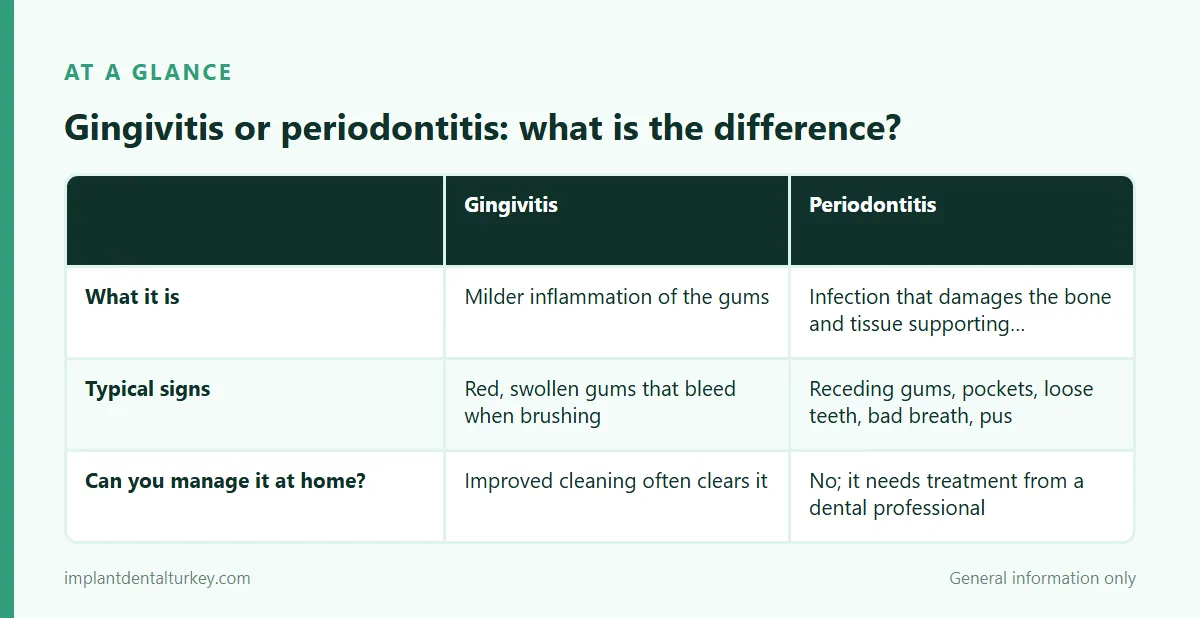
Gingivitis or periodontitis: what is the difference?
| Gingivitis | Periodontitis | |
|---|---|---|
| What it is | Milder inflammation of the gums | Infection that damages the bone and tissue supporting the teeth |
| Typical signs | Red, swollen gums that bleed when brushing | Receding gums, pockets, loose teeth, bad breath, pus |
| Can you manage it at home? | Improved cleaning often clears it | No; it needs treatment from a dental professional |
Gingivitis does not always progress to periodontitis. Healthify also warns that periodontitis can develop without the usual early warning signs, particularly in people who smoke or have a weakened immune system, who may not get bleeding gums at all.
What are the warning signs of gum disease?
The NHS lists gums that bleed when you brush, floss or eat hard food, and gums that are swollen, red and sore. As the disease progresses, Healthify and the NHS describe:
- bad breath or a bad taste in your mouth
- receding gums, making teeth look longer
- pus in or between the gums
- gaps opening up between teeth
- teeth that are sensitive to hot and cold or sore when chewing
- loose teeth
- a dental abscess
The NHS suggests asking for an urgent appointment if your gums are very sore and swollen, teeth are loose, or you notice ulcers, red patches or a lump in your mouth or on your lip.
Who is more at risk?
Anyone can develop gum disease, but Healthify lists factors that raise the risk:
- Smoking, one of the biggest risk factors. It reduces blood supply to the gums and weakens the immune response.
- Diabetes, which increases infection risk and affects healing in the gums.
- Pregnancy, as hormonal changes can make the gums react more strongly to plaque.
- Some medicines that reduce saliva or cause gum overgrowth.
- Places where plaque collects, such as tartar, large or poorly shaped fillings, and badly fitting partial dentures.
- Conditions that affect immunity, including HIV and cancer treatment.
- Family history, although good home care can still prevent problems.
- Cannabis use, which is associated with severe gum disease.
Healthify notes an interesting quirk: when people stop smoking, symptoms that smoking had been hiding, such as bleeding gums, may appear for the first time. That is a sign to get your gums checked, not a reason to keep smoking.
How is gum disease diagnosed and treated?
A dentist or hygienist will ask about your health, look at your gums and measure the depth of the pockets around your teeth with a fine probe. Healthify says healthy pockets are usually less than 3 mm. X-rays may be taken to check for bone loss, and you may be referred to a periodontist, a specialist in gum health.
Treatment depends on severity. According to Healthify and the NHS, options include:
- advice on cleaning, including interdental brushes, and support to stop smoking
- a professional clean by a hygienist
- scaling and root planing, a deep clean that removes plaque and tartar above and below the gum line
- antibiotics or mouthwashes alongside deep cleaning in some cases
- gum surgery, such as flap surgery, for advanced disease
- removal of teeth that cannot be saved
Our article on gum surgery in New Zealand explains what the surgical options involve.
How can you prevent gum disease?
Healthify and the NHS give consistent advice:
- Brush twice a day with fluoride toothpaste and a soft brush. The NHS suggests spitting rather than rinsing afterwards.
- Clean between your teeth every day with floss or interdental brushes.
- Do not use mouthwash straight after brushing.
- Stay smokefree, limit alcohol and avoid cannabis.
- Limit sugary foods between meals.
- Have regular check-ups and professional cleans. Healthify suggests seeing a dentist at least once a year.
Help with treatment costs in New Zealand
Work and Income can help eligible people with immediate and essential dental treatment, up to $1,000 in any 52-week period, which does not need to be repaid. Its page says routine scale and polish is not covered unless it is needed to treat a gum infection. For other options, see our guide on free dental care in New Zealand.
Frequently asked questions
Can gum disease be reversed?
Gingivitis often clears with better cleaning at home. Periodontitis cannot be treated at home, but a dental professional can treat and manage it.
Is gum disease linked to other health problems?
Healthify reports that people with gum disease appear more likely to develop heart disease or have trouble controlling blood glucose, and pregnant people with gum disease appear more likely to have a preterm or low-birthweight baby. The exact mechanism is not fully understood.
Why do my gums bleed when I floss?
Bleeding gums are a common early sign of gum inflammation. If it keeps happening, book a check-up.
How often should I see a dentist for my gums?
Healthify suggests at least once a year, or more often if your dentist recommends it.
Sources
- Healthify, Gum disease
- NHS, Gum disease
- Work and Income, Dental treatment
This article is general information and does not replace advice from your own dentist.