Dental Implants in the Upper Jaw: Bone, Sinus and Timing
Why upper back implants can need a sinus lift, and how that changes the timeline.
Edited and fact-checked by our editorial team.

Dental implants upper jaw cases are common, but the back of the upper jaw can be tricky: bone may be thin and the sinus sits close above it. If bone height is lacking, a sinus lift may come first, with bone usually needing four to 12 months to develop.
Not every upper implant needs extra surgery; much depends on how much bone is available where the tooth is missing. Understanding why the upper back jaw is different helps you make sense of a treatment plan that is longer, or involves more steps, than you expected.
Why is the upper jaw more challenging for implants?
The American Academy of Periodontology (AAP) describes the upper back jaw as traditionally one of the most difficult areas for implants, because of limited bone and its closeness to the sinus. Bone can be lost through gum disease or after teeth are missing, leaving too little height to hold an implant securely. Colgate puts it in practical terms: implants may not be possible when there is not enough bone height in the upper jaw, or the sinuses are too close to the jaw.
Cleveland Clinic notes more generally that implants need enough healthy jawbone, and that bone grafts may be needed where bone has been lost.
What is a sinus lift?
A sinus lift, also called sinus augmentation, adds bone to the upper jaw so implants have enough support. Both the AAP and Colgate describe the same basic steps:
- The gum is opened to expose the bone.
- A small window of bone is cut and gently lifted into the sinus space, which the AAP likens to a trap door.
- The space beneath is filled with bone graft material.
- The gum is closed and the area is left to heal.
Colgate says the procedure is usually carried out by a dental specialist such as an oral and maxillofacial surgeon or a periodontist. The AAP adds that your periodontist can explain the options for bone graft materials.
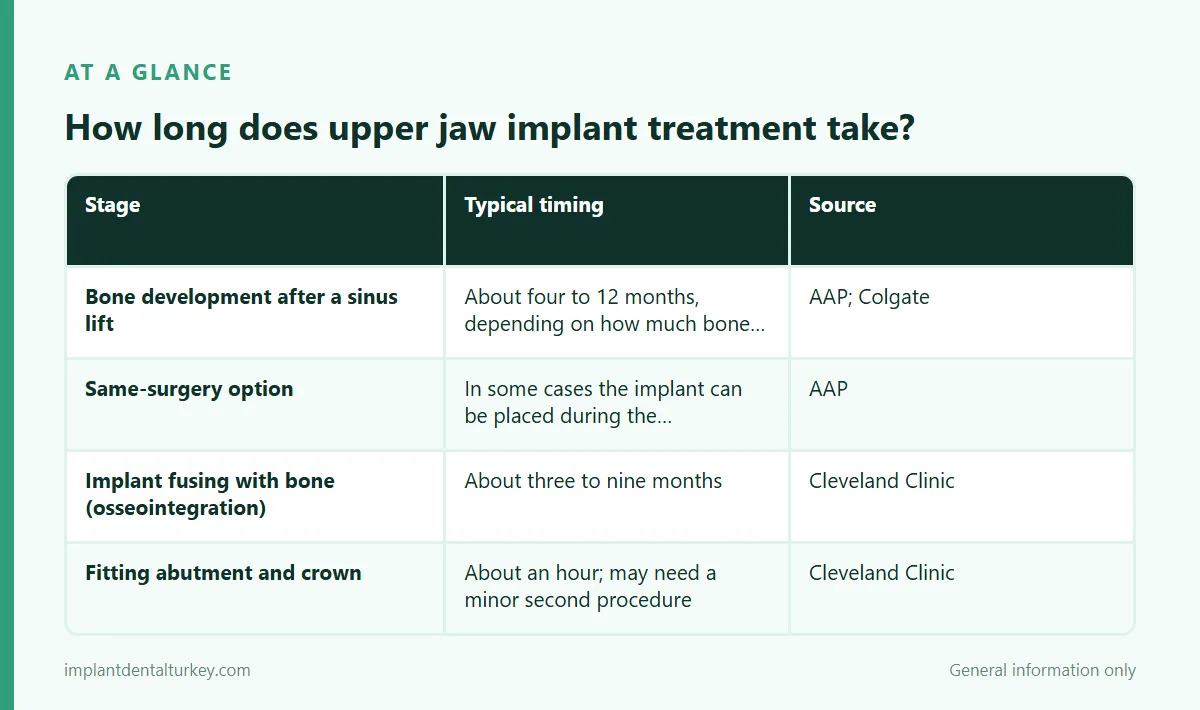
How long does upper jaw implant treatment take?
| Stage | Typical timing | Source |
|---|---|---|
| Bone development after a sinus lift | About four to 12 months, depending on how much bone was needed | AAP; Colgate |
| Same-surgery option | In some cases the implant can be placed during the sinus lift | AAP |
| Implant fusing with bone (osseointegration) | About three to nine months | Cleveland Clinic |
| Fitting abutment and crown | About an hour; may need a minor second procedure | Cleveland Clinic |
Put together, an upper back implant with a sinus lift can take considerably longer than a front tooth with good bone. For an overview of typical timelines, see how long dental implants take in NZ.
What should you expect after a sinus lift?
The AAP says many patients feel only minimal discomfort. Colgate’s recovery advice includes:
- Try not to blow your nose or sneeze forcefully, as this can move graft material and loosen stitches.
- Contact your surgeon if swelling or pain increases, bleeding continues after one to two days, the graft seems dislodged, or you develop a fever.
Colgate identifies the main risk as puncturing or tearing the sinus membrane. Infection is possible but uncommon, and occasionally the graft does not integrate with existing bone. Follow your own surgeon’s written instructions, which will be specific to what was done.
Which questions should you ask about upper jaw implants?
- Is there enough bone height where the implant will go, and how was that measured?
- Will I need a sinus lift or other bone graft, and who will do it?
- Can the implant be placed at the same time, or will it be a separate stage?
- What is the total timeline and cost, including grafting?
For full-arch options in the upper jaw, our guide to full mouth implant costs in NZ explains the alternatives.
Sources
- American Academy of Periodontology, Sinus Augmentation
- Colgate, What Is a Sinus Lift?
- Cleveland Clinic, Dental Implants
This article is general information and is not a substitute for advice from your own dentist.