Can You Get Braces With Dental Implants?
Braces move teeth, not implants. Here's how the two treatments fit together.
Edited and fact-checked by our editorial team.

Can you get braces with dental implants? Yes, but braces can’t move the implant itself. An implant is fused to the bone, so orthodontists move the natural teeth around it, and sometimes use the implant as a fixed anchor. If you need both, ask whether orthodontics should be finished before the implant goes in.
Some adults decide to straighten their teeth after an implant has already been placed; others need both treatments at once. The order of treatment matters, and it’s worth understanding why before you commit to either.
Why can’t braces move a dental implant?
Braces work by moving natural teeth gradually. Implants behave differently. A 2013 review in the Journal of the Indian Society of Periodontology explains that an osseointegrated implant behaves much like an ankylosed tooth, one fused directly to the bone. A 2021 case series in Head & Face Medicine (Bousquet and colleagues) states that an implant cannot be relocated with an orthodontic appliance alone.
Cleveland Clinic describes the healing process as the jawbone fusing to the implant over three to nine months. Once that has happened, the implant is designed to stay exactly where it is.
What does this mean for orthodontic treatment?
| Situation | What usually happens |
|---|---|
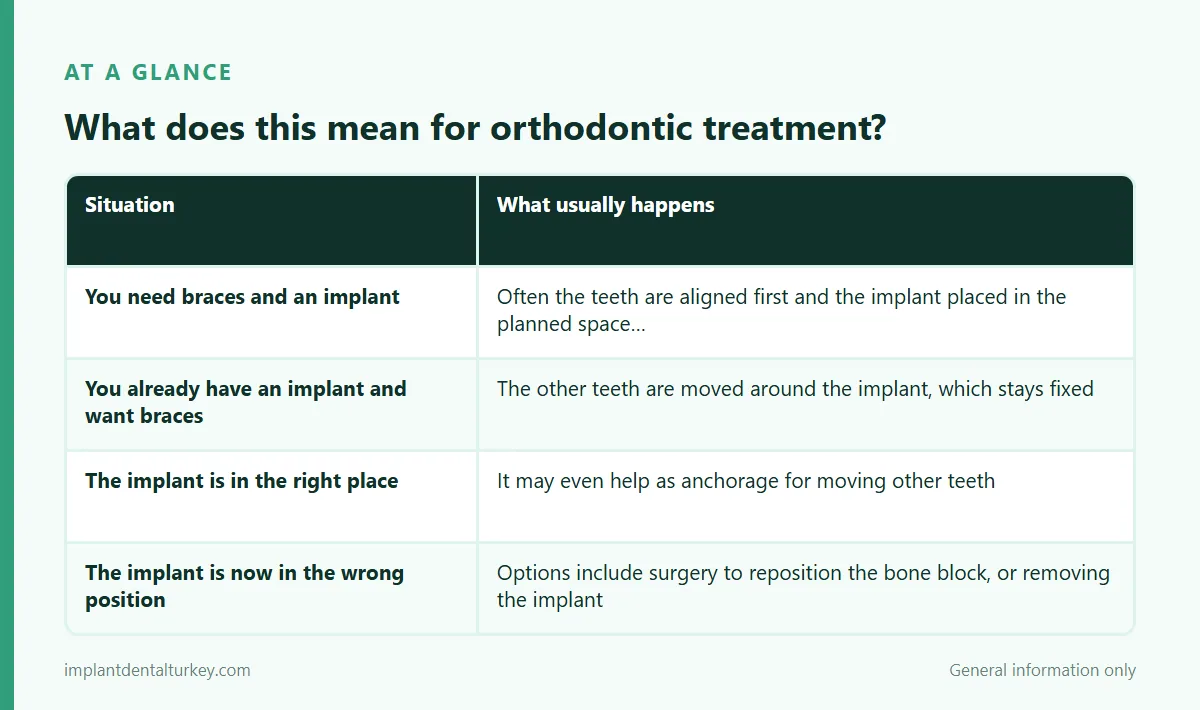
| You need braces and an implant | Often the teeth are aligned first and the implant placed in the planned space; your dentists will advise |
| You already have an implant and want braces | The other teeth are moved around the implant, which stays fixed |
| The implant is in the right place | It may even help as anchorage for moving other teeth |
| The implant is now in the wrong position | Options include surgery to reposition the bone block, or removing the implant |
Bousquet and colleagues note that orthodontic plans must work around the implant, moving all the other teeth while it stays put. They also cite studies showing osseointegrated implants can resist orthodontic forces and serve as anchorage.
What if the implant ends up in the wrong place?
Because teeth and jaws keep changing slowly over life, an implant placed in one position can end up out of line with the teeth around it. The 2021 case series describes this as infraocclusion, where neighbouring teeth continue to erupt past a static implant. Options for a malpositioned implant include segmental osteotomy (surgically moving a block of bone with the implant), distraction techniques, a newer bone-stretching method the authors were investigating, or removing the implant. Removal often leaves a defect needing bone and gum reconstruction. These are specialist procedures, which is one reason careful planning up front matters.
Can teenagers have braces and implants?
Usually orthodontics comes first and the implant waits. Cleveland Clinic says the minimum age for implants is typically 18 and the jaw must have finished growing. The 2013 review explains that implants placed during growth may end up submerged relative to neighbouring teeth, and suggests removable prostheses and orthodontic management of spaces in the meantime. See our article on children’s dental care in New Zealand for more on younger patients.
Questions to ask before starting treatment
- Should I finish orthodontics before the implant, or can it go in now?
- Will my existing implant limit how far my other teeth can move?
- Can the implant be used as an anchor?
- What happens to my bite around the implant over time?
- Do my orthodontist and implant dentist have a shared plan?
Clear aligners are another option to discuss; our guide to Invisalign in New Zealand explains how they work. The same principle applies: the implant won’t move.
Sources
- Bousquet P et al., The application of orthodontic bone stretching for correcting malpositioned dental implants, Head & Face Medicine, 2021
- Shah RA et al., Implants in adolescents, J Indian Soc Periodontol, 2013
- Cleveland Clinic, Dental Implants
This article is general information and is not a substitute for advice from your own dentist.