Dental Implant Stent: What a Surgical Guide Does
How surgical guides position implants, how they are made and their limits.
Edited and fact-checked by our editorial team.

A dental implant stent, also called a surgical guide, is a custom appliance worn during surgery that directs the drill to the planned position, depth and angle for each implant. It is designed from scans and models so the implant lines up with the final tooth.
If your treatment plan mentions a “stent” or “guided surgery”, it does not mean a different type of implant. It describes how the implant is positioned. Here is what the appliance does, how it is made, and what its benefits and limits are according to the dental literature.
What does a surgical stent actually do?
A 2011 article in the Journal of the Indian Prosthodontic Society describes the stent as an appliance used both to evaluate implant sites on X-ray imaging during planning, and to locate the best implant site during surgery. Its purposes include:
- positioning implants accurately, with an angle that suits the planned crown or bridge
- previewing the final restoration and how it relates to nearby structures
- communicating the restorative dentist’s plan to the surgeon when two clinicians are involved
- reducing unnecessary drilling of the bone
How is a dental implant stent made?
Methods vary. The 2011 article sets out a conventional approach: impressions and models of the teeth are made, the planned teeth are waxed up, and an acrylic template is built with channels marking where implants should go. The patient wears the template during a CT scan, with markers in the channels showing up on the images, so the plan can be checked against the bone. The template is then converted into the surgical guide.
A 2020 review in the Journal of Indian Society of Periodontology describes the modern digital version: a 3D cone-beam CT scan is used to plan the implant position on a computer, and a guide is produced to transfer that plan to the mouth.
What are the different types of surgical guide?
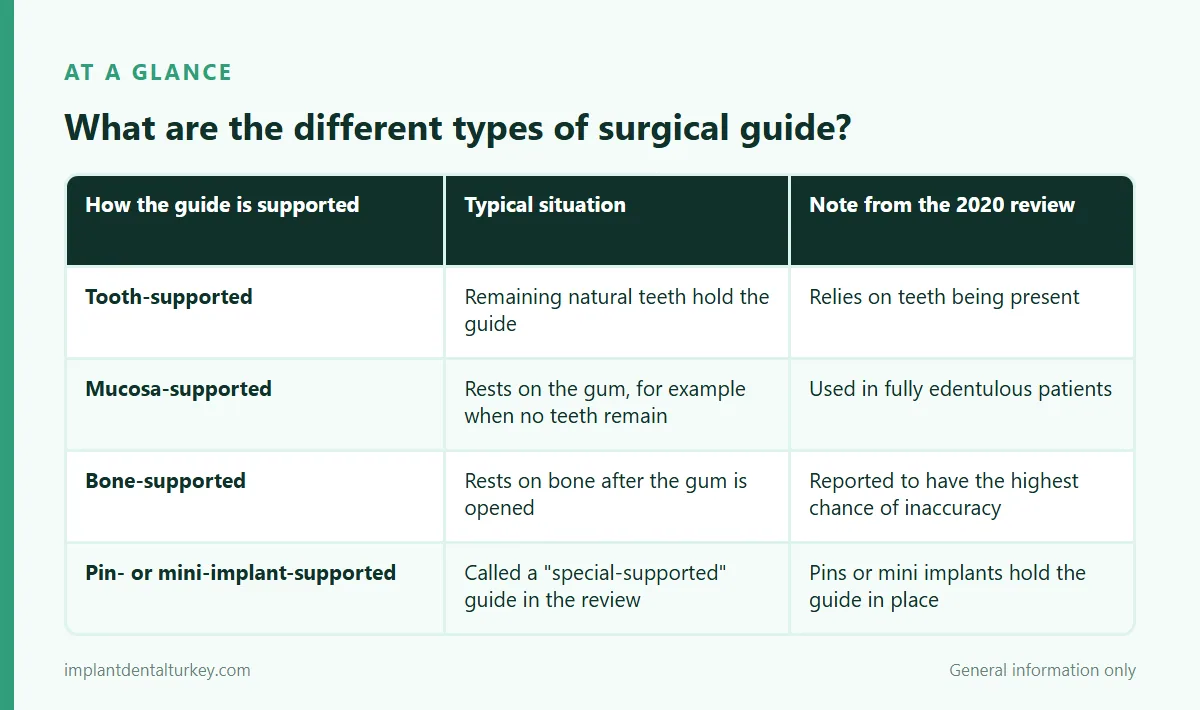
| How the guide is supported | Typical situation | Note from the 2020 review |
|---|---|---|
| Tooth-supported | Remaining natural teeth hold the guide | Relies on teeth being present |
| Mucosa-supported | Rests on the gum, for example when no teeth remain | Used in fully edentulous patients |
| Bone-supported | Rests on bone after the gum is opened | Reported to have the highest chance of inaccuracy |
| Pin- or mini-implant-supported | Called a “special-supported” guide in the review | Pins or mini implants hold the guide in place |
Is guided implant surgery more accurate than freehand placement?
The 2020 review concludes that computer-guided static placement is more accurate than freehand placement, and that guided surgery offers precise, efficient implant placement. The 2011 article likewise associates stents with more accurate placement and better control of parallelism between several implants. Where the gum does not need to be opened (a “flapless” approach), the 2020 review notes possible benefits such as less bone loss and better gum aesthetics.
What are the limitations?
The same review is clear that guided surgery should not be carried out blindly and that long-term studies are still needed. Drawbacks it lists include:
- a learning curve, with the clinician’s skill strongly affecting results
- the risk of a guide fracturing during surgery
- difficulty using guides where mouth opening is limited or at the back of the mouth
- small errors across the digital workflow that can add up
Once a static guide is fitted, the implant position cannot be changed during surgery, the review notes, so the planning stage matters.
What should you ask your implant team?
- Will my implants be placed with a surgical guide, and is it tooth-, gum- or bone-supported?
- Which scans will be used to plan the position?
- Is there a cost for the guide, and is it included in the quote?
For how guided placement fits into the wider process, see our step-by-step guide to implant treatment in NZ and our article on digital dentistry in New Zealand.
Sources
- Talwar N, Singh BP, Chand P, Pal US. Use of Diagnostic and Surgical Stent: A Simplified Approach for Implant Placement. Journal of the Indian Prosthodontic Society, 2011
- Kalaivani G, Balaji VR, Manikandan D, Rohini G. Expectation and reality of guided implant surgery protocol using computer-assisted static and dynamic navigation system. Journal of Indian Society of Periodontology, 2020
This article is general information and is not a substitute for advice from your own dentist.