Teeth Braces: Types, Treatment Time and Life With Braces
An overview of the main types of teeth braces, how treatment works, how long it takes and how to look after your teeth along the way.
Edited and fact-checked by our editorial team.
Teeth braces are orthodontic appliances that use brackets and wires, or a series of clear trays, to apply gentle, steady pressure that moves teeth into better positions over months to a few years.
People get braces for many reasons: crowded or crooked teeth, gaps, teeth that stick out, or upper and lower jaws that do not meet properly. Whether you are thinking about braces for your child or for yourself as an adult, it helps to understand the main types, how treatment runs, what daily life with braces involves, and how to check who is providing your care in New Zealand.
What problems can braces fix?
The NHS and Cleveland Clinic list the most common reasons for orthodontic treatment:
- teeth that are crowded, crooked or rotated
- teeth that stick out
- large gaps between teeth
- upper and lower jaws that do not meet properly, such as an overbite or underbite
- difficulty chewing or keeping teeth clean because of their position
Cleveland Clinic notes that straighter teeth can also be easier to clean, which may help reduce the risk of decay and gum disease.
What types of braces are there?
Cleveland Clinic describes five main options. Your orthodontist or dentist will explain which ones suit the kind of problem you have and how severe it is.
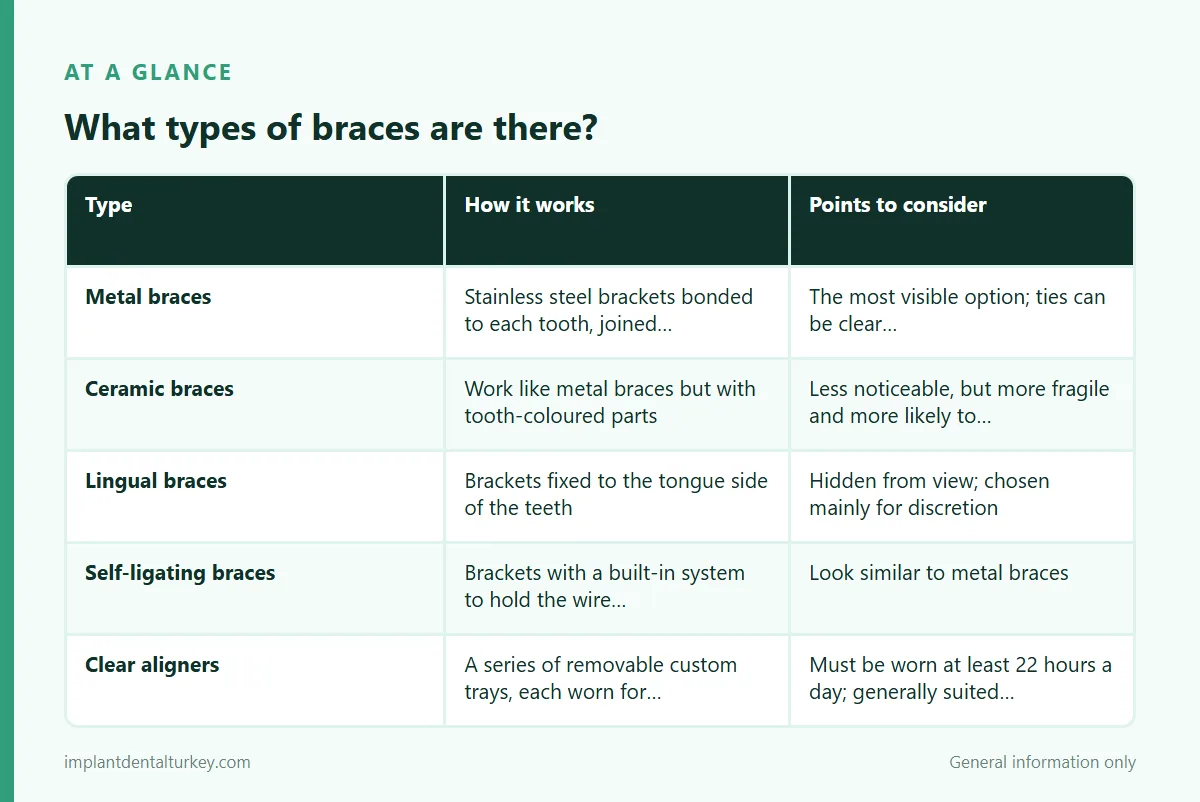
| Type | How it works | Points to consider |
|---|---|---|
| Metal braces | Stainless steel brackets bonded to each tooth, joined by an archwire held with small elastic ties | The most visible option; ties can be clear, tooth-coloured or brightly coloured |
| Ceramic braces | Work like metal braces but with tooth-coloured parts | Less noticeable, but more fragile and more likely to break |
| Lingual braces | Brackets fixed to the tongue side of the teeth | Hidden from view; chosen mainly for discretion |
| Self-ligating braces | Brackets with a built-in system to hold the wire instead of elastic ties | Look similar to metal braces |
| Clear aligners | A series of removable custom trays, each worn for about two weeks | Must be worn at least 22 hours a day; generally suited to mild to moderate cases |
If you are curious about the aligner route specifically, our article on clear aligner treatment in New Zealand covers the process in more detail.
How does treatment with fixed braces work?
The NHS describes the basic steps. Small brackets are glued to each tooth, a wire is threaded through them, and elastic modules hold the wire in place. The wire applies gentle pressure that moves the teeth over time. You then return to the orthodontist every 6 to 8 weeks or so for adjustments.
Treatment length varies. The NHS says fixed braces usually stay on for 1 to 2 years. Cleveland Clinic gives an average of about two years, with some people finishing in under 12 months and others needing up to three years, depending on how much correction is needed.
Retainers after braces
Once the braces come off, teeth tend to drift back towards their old positions. Both the NHS and Cleveland Clinic say you will need a retainer afterwards, and your orthodontist will tell you how long to wear it.
Is there a right age for braces?
The NHS says braces are often recommended for children and teenagers once all their adult teeth have come through. Cleveland Clinic notes that roughly ages 9 to 14 can be a helpful window because the jaw and facial bones are still developing, but it also says there is no upper age limit. Adults can get effective results, although treatment may take longer.
What is daily life like with braces?
Most people feel some discomfort for a few days after braces are fitted and again after adjustments. Cleveland Clinic suggests soft foods such as pasta, mashed potato, scrambled eggs, yoghurt and soup during those first days, and orthodontic wax over any bracket or wire rubbing on your cheeks or lips. Ask your orthodontist or pharmacist which pain relief is suitable for you.
Keeping teeth clean takes extra effort. The NHS and Cleveland Clinic recommend:
- brushing with fluoride toothpaste at least twice a day, and after meals if you can
- cleaning between teeth and under the wire every day with interdental brushes, floss threaders or similar aids
- limiting sugary food and drink, which can cause decay around the brackets
- avoiding hard, crunchy or sticky foods that can break brackets or wires
- keeping up regular dental check-ups and cleans
Contact your orthodontist if pain lasts more than a few days, your gums become very red, swollen or sore, or a bracket or wire breaks. If one of your front teeth has ever been knocked or damaged, mention it before treatment starts, as the NHS notes it may need extra care.
How do you check who is providing your braces?
The Dental Council of New Zealand keeps an online Oral Health Practitioner Register covering registered oral health practitioners. It lets you check whether someone is currently registered, their scope of practice and any conditions on their practice.
The Dental Council also flags a specific risk: remote or do-it-yourself aligner services, where you take your own impressions and receive trays by post. It advises consumers to be wary of safety risks when there is little or no contact with a New Zealand-registered practitioner during treatment.
Help with costs
Work and Income’s dental treatment grant, which helps eligible people with immediate and essential treatment, specifically excludes orthodontics. Ask for a written treatment plan and quote that sets out the length of treatment, the number of visits, retainers and what happens if a bracket breaks. Our guide to dental payment plans in New Zealand explains how spreading costs can work.
Frequently asked questions
Do braces hurt?
Cleveland Clinic describes mild, temporary discomfort for a few days after fitting and after adjustments rather than ongoing pain. Pain that does not settle should be checked by your orthodontist.
How long will I need to wear braces?
Often around 1 to 2 years for fixed braces, though some cases are shorter and some take up to three years.
Can adults get braces?
Yes. Cleveland Clinic says there is no age limit for orthodontics, although adult treatment may take longer.
Can I chew gum with braces?
The NHS advises against chewing gum with fixed braces because it can get stuck. Check with your orthodontist about your own appliance.
Sources
- Cleveland Clinic, Teeth Braces: Types and How They Work
- NHS, Braces
- Dental Council of New Zealand, Resources and guides for patients
- Dental Council of New Zealand, Oral Health Practitioner Register
- Work and Income, Dental treatment
This article is general information and does not replace advice from your own dentist.