Teeth Cleaning: Professional Scale and Polish vs Home Care
A plain guide to professional teeth cleaning: scaling and polishing, why tartar can't be brushed away, deep cleans for gum disease, how often to go, and daily home care.
Edited and fact-checked by our editorial team.

Professional teeth cleaning, often called a scale and polish, is when a dentist or dental hygienist removes plaque and hardened tartar from your teeth and then polishes them. It complements daily brushing and flossing rather than replacing them.
Home care and professional cleaning do different jobs. Brushing and flossing remove soft plaque every day, while a professional clean deals with the tartar that home care can’t shift. This guide explains what happens at a cleaning appointment, why tartar matters for your gums, how a routine clean differs from a deep clean, and what good home care looks like in between.
Why home brushing can’t remove everything
Healthify explains that bacteria in the mouth form a sticky plaque on teeth. If plaque isn’t removed by regular brushing and flossing, it can harden into tartar, also called calculus, which then makes more plaque build up faster.
Cleveland Clinic describes tartar as hardened dental plaque that forms above and below the gum line. It can’t be removed by brushing and flossing; only a dentist or dental hygienist can remove it with specialised instruments. Cleveland Clinic also warns that trying to scrape tartar off yourself can damage your teeth and gums.
Left in place, tartar can lead to gingivitis (red, swollen or bleeding gums) and gum disease, and tartar trapped below the gum line can contribute to bone loss, according to Cleveland Clinic.
What happens during a professional teeth cleaning
Cleveland Clinic outlines the main steps of a routine dental cleaning:
- Scaling. The dentist or hygienist removes plaque and tartar using hand instruments and an ultrasonic scaler, a vibrating tool. Scraping sounds are normal.
- Polishing. Teeth are polished with a soft rubber cup and a special paste.
- Fluoride (optional). Your dentist may suggest a fluoride treatment to strengthen teeth and help prevent decay.
- X-rays (sometimes). These may be taken to help find problems that aren’t visible during an examination.
A routine cleaning usually takes 30 to 60 minutes, Cleveland Clinic says, and more specialised cleanings can take longer. The procedure shouldn’t hurt, although some people have sensitive teeth or sore gums for a few days afterwards. If you feel anxious about dental visits, it’s worth telling the team before you start.
Routine clean versus deep clean
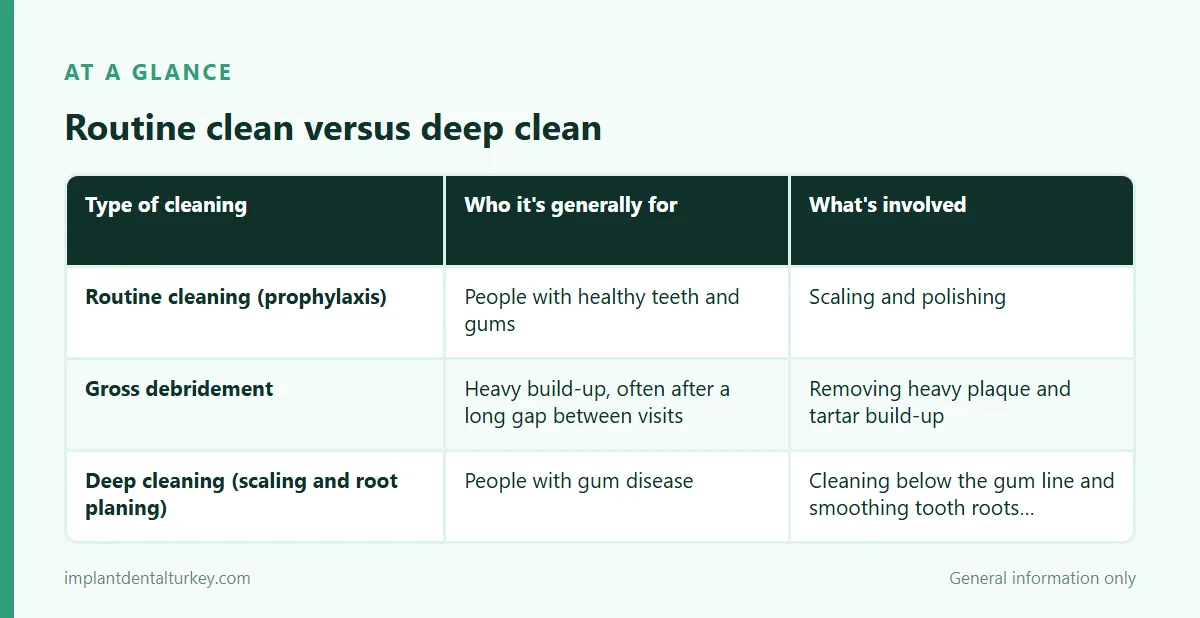
Not every cleaning is the same. Cleveland Clinic describes three broad types:
| Type of cleaning | Who it’s generally for | What’s involved |
|---|---|---|
| Routine cleaning (prophylaxis) | People with healthy teeth and gums | Scaling and polishing |
| Gross debridement | Heavy build-up, often after a long gap between visits | Removing heavy plaque and tartar build-up |
| Deep cleaning (scaling and root planing) | People with gum disease | Cleaning below the gum line and smoothing tooth roots, done with numbing |
Healthify describes scaling and root planing as a deep clean that removes plaque and tartar above and below the gum line and smooths the tooth roots. It is one of the main professional treatments for gum disease, which Healthify says cannot be treated at home. Where inflammation and deep pockets remain after deep cleaning, flap surgery may be considered; our article on gum surgery in NZ explains what that involves.
How often should you have your teeth cleaned?
Healthify recommends visiting your dentist or hygienist at least once a year, and says your dentist will advise how often you should return. Cleveland Clinic notes that most dentists recommend a cleaning about every six months, and that people with gum disease, a family history of cavities, a weakened immune system, or ongoing illness or stress may need cleanings more often.
The right interval depends on your own mouth, so it’s a question to ask at your next check-up rather than a fixed rule.
Paying for teeth cleaning in New Zealand
Work and Income can help eligible people with immediate and essential dental treatment, but its dental treatment page lists “scale and polish or teeth cleaning” among the things not covered, unless it is needed for a gum infection. Fees for a routine visit vary between practices; for more on that, see how much a dentist visit costs in NZ.
Home care between cleanings
A professional clean lasts longer when daily care is good. Healthify’s advice includes:
- Brush twice a day with fluoride toothpaste for at least two minutes, using a soft toothbrush.
- Angle the brush at about 45 degrees towards the gums, and brush the chewing surfaces too.
- Clean between your teeth once a day with floss or interdental brushes. Interdental brushes suit larger gaps and braces.
- Don’t floss too hard, as this can harm your gums.
- Cut back on how much and how often you have sugary foods and drinks, and drink water after eating.
- Chew sugar-free gum to help produce saliva, which neutralises acid.
Healthify also lists not smoking, limiting alcohol and avoiding cannabis as ways to help prevent gum disease. Cleveland Clinic adds that avoiding tobacco helps limit tartar build-up.
Frequently asked questions
Does professional teeth cleaning hurt?
Cleveland Clinic says a routine cleaning shouldn’t hurt, although teeth may feel sensitive or gums sore for a few days afterwards. Deep cleaning for gum disease is done with numbing.
Can I remove tartar at home?
No. Cleveland Clinic states that tartar can’t be removed by brushing and flossing, and that scraping it off yourself can damage your teeth and gums. Only a dentist or dental hygienist should remove it.
Who does teeth cleaning in New Zealand?
Cleanings are carried out by dentists or dental hygienists. Healthify suggests seeing your dentist or hygienist at least once a year.
Is a scale and polish the same as treatment for gum disease?
Not quite. Cleveland Clinic describes a routine cleaning as being for people with healthy teeth and gums. Scaling and root planing is a deeper clean below the gum line used to treat gum disease.
Sources
- Cleveland Clinic, Dental Cleaning
- Cleveland Clinic, Tartar on Teeth (Dental Calculus): Causes & Removal
- Healthify, Gum disease
- Healthify, Taking care of your teeth
- Work and Income, Dental treatment
This article is general information and doesn’t replace advice from your own dentist.