Ceramic Braces: How They Compare With Metal and What to Ask
Ceramic braces blend in with your teeth but break more easily than metal; here is what research says about their trade-offs.
Edited and fact-checked by our editorial team.

Ceramic braces work in the same way as metal braces, using brackets and a wire to move teeth, but the brackets are tooth-coloured so they are less noticeable; the trade-off is that they are more fragile.
For many teenagers and adults, how braces look is a real consideration, especially for a treatment that can last a couple of years. Ceramic brackets were developed as a less visible alternative to stainless steel. Below we explain what they are made of, how they compare with metal, the drawbacks that research has identified, and the questions worth asking before you decide.
What are ceramic braces?
Cleveland Clinic describes ceramic (sometimes called clear) braces as fixed braces that work like traditional metal ones, except the brackets, wires and ties are tooth-coloured and blend in with the teeth. A bracket is bonded to each tooth, an archwire runs between them, and regular adjustments gradually move the teeth.
A 2020 literature review in the IP Indian Journal of Orthodontics and Dentofacial Research notes that ceramic brackets were introduced in 1986 as an aesthetic alternative to metal. They are made from alumina (aluminium oxide) and come in two forms:
- Polycrystalline brackets, made by fusing aluminium oxide particles together. The process is relatively inexpensive but can leave tiny imperfections.
- Monocrystalline brackets, made by melting the material and cooling it slowly, which leaves fewer impurities and gives and greater strength. The review notes, however, that a scratch can reduce their fracture resistance to the level of polycrystalline brackets or below.
How do ceramic braces compare with metal braces?
| Ceramic braces | Metal braces | |
|---|---|---|
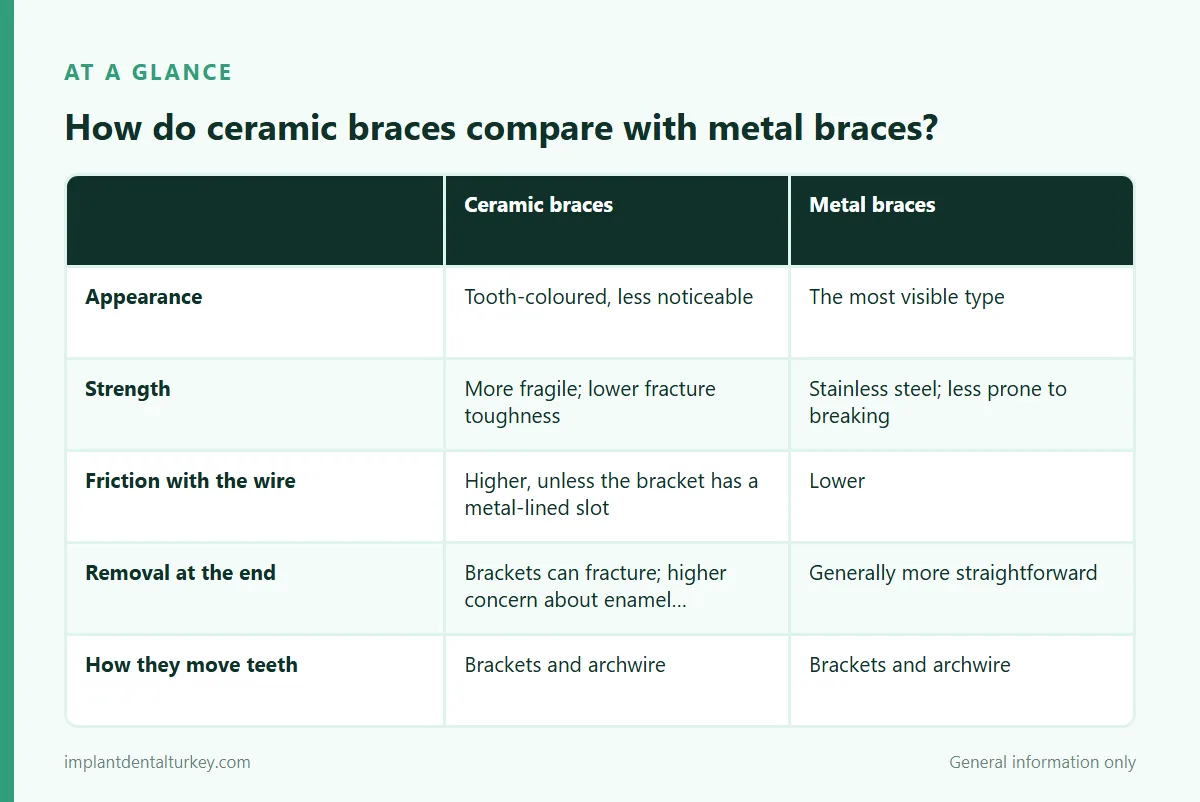
| Appearance | Tooth-coloured, less noticeable | The most visible type |
| Strength | More fragile; lower fracture toughness | Stainless steel; less prone to breaking |
| Friction with the wire | Higher, unless the bracket has a metal-lined slot | Lower |
| Removal at the end | Brackets can fracture; higher concern about enamel damage | Generally more straightforward |
| How they move teeth | Brackets and archwire | Brackets and archwire |
A 2021 study in The Scientific World Journal summarises the appeal: ceramic brackets have an aesthetic quality preferred by many patients, can withstand orthodontic forces, and resist staining in a way that older plastic brackets did not.
What are the drawbacks of ceramic braces?
They break more easily
Cleveland Clinic states plainly that ceramic braces are more fragile than metal and more likely to break. The 2020 review explains why: ceramic has much lower fracture toughness than metal. If a bracket breaks, contact your orthodontist rather than waiting for your next adjustment.
More friction against the wire
The 2021 study notes that ceramic brackets create more friction between the archwire and the bracket. To reduce this, manufacturers introduced brackets with a stainless steel lining in the slot where the wire sits, which also reinforces the bracket against twisting forces during treatment.
Removal can be more delicate
Taking ceramic brackets off at the end of treatment needs care. The 2021 study reports that, because they are brittle, ceramic brackets can break during removal and that enamel damage is a concern. The 2020 review describes enamel fracture as a major concern because it can affect appearance and may need a filling or other repair. It adds that using the manufacturer’s recommended removal pliers helps reduce bracket failure, and that grinding off remnants should be done with water or air cooling to avoid heating the tooth’s pulp.
Possible wear on opposing teeth
The 2020 review notes that ceramic brackets on the lower front teeth can wear the upper front teeth that bite against them. This depends on how your teeth meet, so it is worth asking your orthodontist whether it applies to your bite.
Who might choose ceramic braces?
Ceramic braces are often considered by people who want fixed braces but would prefer them to be less obvious. Cleveland Clinic lists other discreet options too: lingual braces fitted behind the teeth, and removable clear aligners, which it says generally suit mild to moderate cases. Severe cases may need fixed braces. Only a dentist or orthodontist who has examined you can say which options are realistic for your teeth.
Looking after ceramic braces
Day-to-day care is the same as for any fixed brace. The NHS and Cleveland Clinic recommend:
- brushing with fluoride toothpaste at least twice a day
- cleaning between teeth and around the brackets daily with interdental brushes or floss threaders
- avoiding hard, crunchy and sticky foods, which can break brackets
- cutting food into smaller pieces
- limiting sugary food and drink
- wearing a retainer after treatment, as instructed
Because ceramic brackets break more easily, being careful with hard foods matters even more. Contact your orthodontist if a bracket breaks or comes loose, or if pain lasts more than a few days.
Questions to ask before you choose
- Is my case suitable for ceramic brackets, and are there any teeth where you would use metal instead?
- Do the brackets you use have a metal-lined slot?
- How do you remove ceramic brackets, and how do you protect the enamel?
- Could brackets on my lower teeth wear my upper teeth?
- What happens, and what does it cost, if a bracket breaks?
You can check a practitioner’s registration and scope of practice on the Dental Council of New Zealand’s Oral Health Practitioner Register. Our guide on how to choose a dental clinic in New Zealand has more questions to ask.
Frequently asked questions
Do ceramic braces work as well as metal braces?
Cleveland Clinic says they work the same way as metal braces. Treatment planning, not bracket colour, determines what can be corrected, so ask your orthodontist whether ceramic suits your case.
Do ceramic braces stain?
Research describes ceramic brackets as resistant to staining compared with older plastic brackets. Good cleaning helps keep the area around them looking tidy.
Are ceramic braces more likely to break?
Yes. Ceramic has lower fracture toughness than metal, so brackets can chip or break more easily.
How long do ceramic braces take?
Treatment time depends on the problem being corrected rather than the bracket material. Cleveland Clinic gives an average of about two years for braces in general.
Sources
- Cleveland Clinic, Teeth Braces: Types and How They Work
- The Scientific World Journal (via PubMed Central), Enamel Surface Damage following Debonding of Ceramic Brackets: A Hospital-Based Study
- IP Indian Journal of Orthodontics and Dentofacial Research, Debonding of orthodontic ceramic brackets: a comprehensive review of the literature, Part 1
- NHS, Braces
- Dental Council of New Zealand, Oral Health Practitioner Register
This article is general information and does not replace advice from your own dentist.