Will Dental Implants Cure Gum Disease? What to Know First
Implants replace teeth, not gum health. Here's how gum disease affects implant plans.
Edited and fact-checked by our editorial team.

Will dental implants cure gum disease? No. Implants replace missing teeth, but they don’t treat the infection behind gum disease. Active gum disease usually has to be brought under control before implants are placed, and a history of gum disease raises the risk of a similar infection around implants later.
Some people hope that removing diseased teeth and replacing them with implants will end their gum problems for good. The reality is more nuanced, and knowing it helps you plan treatment that lasts.
Why can’t implants cure gum disease?
Periodontitis is a bacterial infection that damages the gums and, over time, the bone supporting the teeth. Cleveland Clinic says plainly that periodontitis can’t be cured, although it can be managed, and it can come back even after treatment. Cleveland Clinic also names periodontitis as the main cause of tooth loss in adults.
Replacing teeth does not remove the bacteria, habits or risk factors that caused the disease. That is why the same plaque-driven process can affect the gum and bone around an implant.
Can you have implants if you have gum disease?
Not while it is active and untreated. Cleveland Clinic lists active or untreated gum disease among the reasons implants may not be suitable, and Cork University Dental School and Hospital says severe gum disease may make implants impossible for some people. Once the disease is under control, implants may become an option, depending on your bone and overall health.
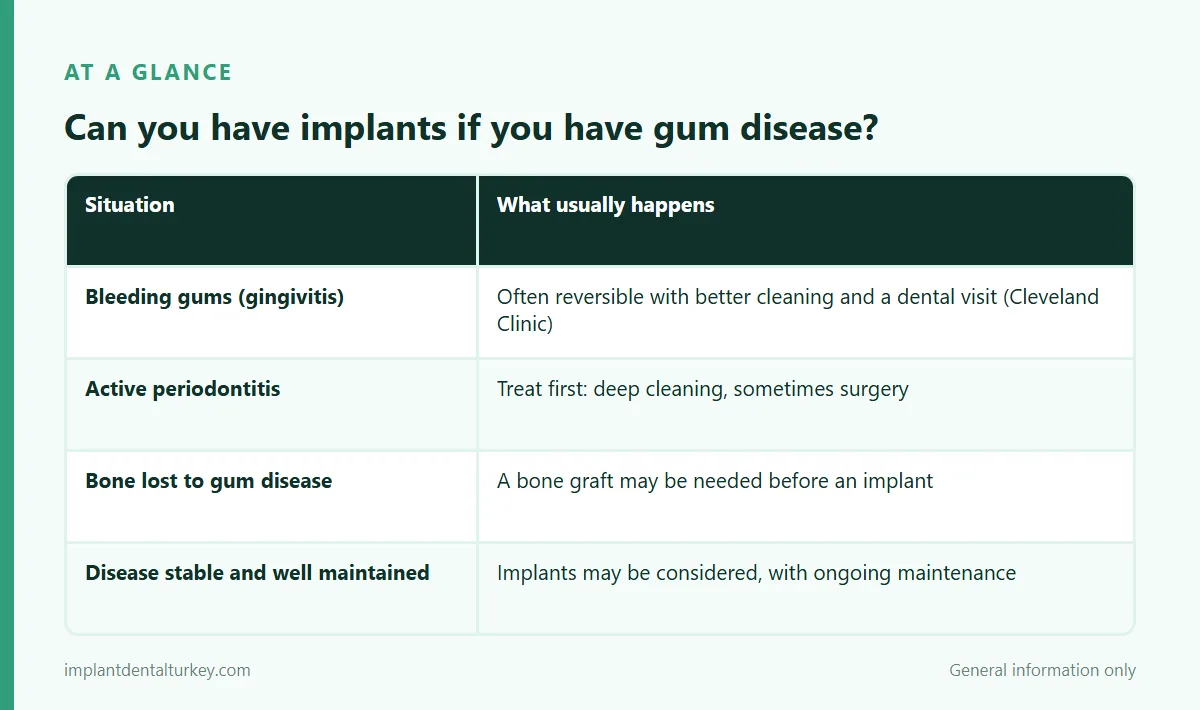
| Situation | What usually happens |
|---|---|
| Bleeding gums (gingivitis) | Often reversible with better cleaning and a dental visit (Cleveland Clinic) |
| Active periodontitis | Treat first: deep cleaning, sometimes surgery |
| Bone lost to gum disease | A bone graft may be needed before an implant |
| Disease stable and well maintained | Implants may be considered, with ongoing maintenance |
What is peri-implantitis?
Peri-implantitis is the implant version of periodontitis. A 2025 review in Bioinformation describes it as a progressive inflammatory disease of the soft and hard tissues around an implant, usually developing from peri-implant mucositis, which is a reversible inflammation of the gum around the implant. Signs include bleeding on probing, pus, deeper pockets and bone loss on X-rays, and early disease can be silent.
The same review lists past gum disease, smoking, poorly controlled diabetes, poor oral hygiene and excess cement as linked factors, and notes that a lack of regular professional maintenance was associated with disease progression. The British Society of Periodontology also names a history of periodontitis and smoking as factors that increase the risk of gum disease around implants.
How do you protect implants if you’ve had gum disease?
- Get gum disease treated and stable first. Cleveland Clinic describes treatments ranging from scaling and root planing to surgery for severe cases.
- Clean daily. The British Society of Periodontology recommends brushing for two minutes, twice daily, with interdental brushes for areas a toothbrush can’t reach.
- Watch for bleeding. The BSP says healthy gums don’t bleed; bleeding suggests inflammation and is a reason to see your dentist.
- Keep maintenance visits. The 2025 review reports that patients in long-term supportive care had lower incidence and severity of peri-implantitis.
- Tackle risk factors. Smoking and poorly controlled diabetes are both linked to higher risk.
If gum treatment is part of your plan, our article on gum surgery in NZ explains what to expect.
Do implants still help people who lost teeth to gum disease?
They can. Cleveland Clinic notes that missing teeth can be replaced with implants or bridges, and implants can restore chewing. The key is treating them as one part of long-term gum care rather than a cure. Read our guide to the implant procedure in New Zealand for the steps involved.
Sources
- Cleveland Clinic, Periodontitis
- Cleveland Clinic, Dental Implants
- Javiya P et al., Peri-implantitis: Etiology, prevention and management strategies, Bioinformation, 2025
- British Society of Periodontology and Implant Dentistry, Looking after your implants
- Cork University Dental School and Hospital, Patient Information Leaflet: Implant Surgery
This article is general information and is not a substitute for advice from your own dentist.