Mouth Guard for Teeth Grinding: How Night Guards Help
What a night guard does for teeth grinding, how custom and store-bought guards compare, how to look after one, and the self-care steps Health NZ suggests alongside it.
Edited and fact-checked by our editorial team.
A mouth guard for teeth grinding, also called a night guard or dental splint, is a hard guard worn over the teeth, usually at night, to protect them from wear and damage caused by grinding and clenching.
It does not stop grinding itself. It acts as a barrier so the force lands on the guard rather than on your enamel. Below we explain what grinding (bruxism) can do to teeth, how night guards differ from sports mouthguards, the difference between store-bought and dentist-made guards, and the other steps Health NZ suggests alongside a guard.
What teeth grinding does to your teeth and jaw
Health NZ describes teeth grinding and clenching as rubbing or squeezing the teeth together, either while awake or asleep. It is common in children and young people, most of whom grow out of it, but it can happen at any age.
Teeth are not meant to be in constant contact. Health NZ explains that excessive or forceful contact can wear down tooth enamel. Healthify classifies this type of wear as attrition, which it describes as being “caused by an internal source, eg, tooth grinding”, and notes that once enamel is lost it cannot be replaced naturally.
Signs that Health NZ and the NHS list include:
- flattened, chipped, fractured or loose teeth
- tooth pain or sensitivity
- tired or tight jaw muscles, or jaw, face or neck pain
- earache-like pain and dull headaches
- damage to the inside of the cheek
- disturbed sleep
Many people don’t realise they grind in their sleep. Health NZ notes that a bed partner may notice the sound first, although not everyone who grinds makes noise.
How a night guard works
According to Health NZ, a dentist may suggest a mouthguard if grinding is causing tooth pain or sensitivity. It works like a sports mouthguard but is harder, and protects the teeth from damage. Health NZ says a dentist-made guard fits precisely over the upper teeth, and the NHS describes a custom guard fitting over either the upper or lower teeth.
Cleveland Clinic adds that night guards may also reduce jaw joint (TMJ) symptoms. Most fit the upper teeth, though a dentist may recommend a lower guard as well. The ADA’s MouthHealthy site points out that night guards are different from sports mouthguards, which have extra cushioning that is typically uncomfortable to sleep in.
Store-bought versus dentist-made guards
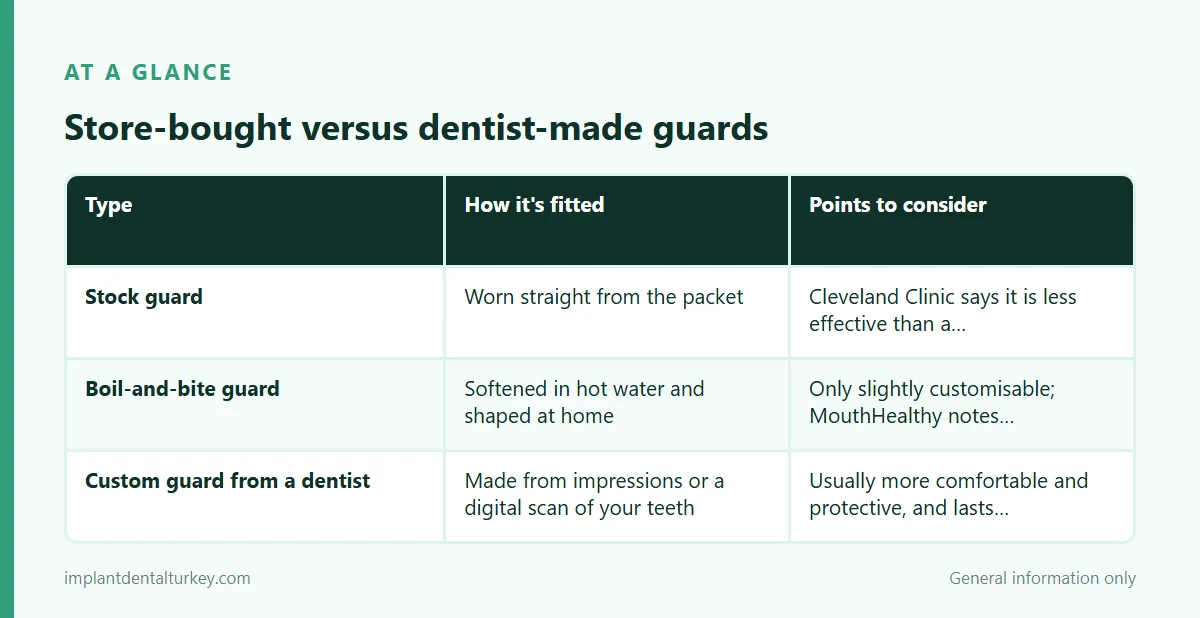
Health NZ notes you can buy a guard online or from a sports store, or have a dentist custom-make one. The sources we reviewed describe these trade-offs:
| Type | How it’s fitted | Points to consider |
|---|---|---|
| Stock guard | Worn straight from the packet | Cleveland Clinic says it is less effective than a custom guard for grinding |
| Boil-and-bite guard | Softened in hot water and shaped at home | Only slightly customisable; MouthHealthy notes over-the-counter guards may not protect as well |
| Custom guard from a dentist | Made from impressions or a digital scan of your teeth | Usually more comfortable and protective, and lasts longer, according to Cleveland Clinic |
Cleveland Clinic explains that for a custom guard, the dentist takes impressions with dental putty or a handheld digital scanner, and a dental lab makes the guard. The process can take up to two weeks. A poorly fitting guard can cause soreness in the teeth, gums or jaw, and a dentist can adjust a guard that doesn’t fit well.
Caring for your mouth guard
Cleveland Clinic’s care advice is straightforward:
- Clean your teeth before putting the guard in.
- After each use, rinse it in cool water, scrub it with a brush and soapy water, and let it air dry.
- Keep it away from extreme heat, such as hot water or direct sunlight, which can warp it.
- Store it in a sturdy, vented case, out of reach of pets.
- Take it to your dental check-ups so it can be checked for cracks or wear.
Custom guards can last several years with proper care, while store-bought guards may need replacing a few times a year. Children and teens may need replacements more often as their mouths grow.
Other ways to manage grinding alongside a guard
Because a guard protects teeth rather than treating the cause, Health NZ also suggests self-care steps:
- Reduce stress: music, warm baths, physical activity, calm breathing, yoga or progressive muscle relaxation.
- Watch evening drinks: avoid caffeine and alcohol in the evening.
- Sleep habits: a regular bedtime and a dark, cool, quiet bedroom.
- Food: avoid hard foods and limit sticky foods if your teeth or jaw are sore.
- Jaw exercises: gentle tongue presses, wide yawns and shoulder rolls, repeated through the day.
- Ice or heat: a wrapped ice pack for severe pain, or a warm moist towel for mild to moderate pain, for 10 to 15 minutes at a time.
Health NZ also lists possible contributing factors, including stress and anxiety, sleep problems such as snoring or sleep apnoea, an abnormal bite, some medicines including SSRI antidepressants, smoking, and heavy alcohol or caffeine use. A physiotherapist with an interest in jaw problems can help, and underlying conditions such as sleep apnoea or anxiety may need their own treatment.
If grinding has already damaged teeth, Health NZ notes that severe cases may need dental treatment such as reshaping the chewing surfaces or crowns. Our guide to dental crown types in NZ explains those options.
When to see a dentist
The NHS suggests seeing a dentist if you grind your teeth and have tooth damage or sensitivity, pain in your jaw, face or ear, if a partner says you grind in your sleep, or if you’re worried about your child grinding. Health NZ adds that you should seek help if symptoms don’t improve with self-care. A GP can help with causes such as stress, anxiety, smoking or alcohol.
Frequently asked questions
Can I use a sports mouthguard for teeth grinding?
MouthHealthy notes that sports mouthguards have extra cushioning that is typically uncomfortable for sleep. Night guards are designed for grinding and, according to Health NZ, are harder than sports guards.
Will a mouth guard stop me grinding my teeth?
A guard protects your teeth from damage; it doesn’t remove the cause. Health NZ recommends pairing it with self-care steps such as stress reduction and better sleep habits.
Is an over-the-counter guard good enough?
Health NZ lists both store-bought and dentist-made guards as options. MouthHealthy and Cleveland Clinic note that over-the-counter guards may not fit or protect as well as a custom guard, so it’s worth discussing with your dentist.
Do children need a night guard for grinding?
Health NZ says most children grow out of grinding. If you’re concerned about your child, the NHS suggests talking to a dentist.
Sources
- Health NZ | Te Whatu Ora, Teeth grinding and clenching (bruxism)
- NHS, Teeth grinding (bruxism)
- Healthify, Tooth wear
- Cleveland Clinic, Mouth Guards: Types & Purpose
- American Dental Association MouthHealthy, Teeth Grinding
This article is general information and doesn’t replace advice from your own dentist.