Dental Implant Parts: Post, Abutment and Crown Explained
What each component of an implant does and when it's fitted.
Edited and fact-checked by our editorial team.

The main dental implant parts are the implant post (a screw-like fixture in the jawbone), the abutment (a connector that comes up through the gum) and the restoration on top, which can be a crown, bridge or denture. During healing, a temporary healing cap may sit on the implant.
Treatment plans and quotes may list each component separately, which can be confusing. This guide explains what each part is, what it’s made of and when it’s fitted.
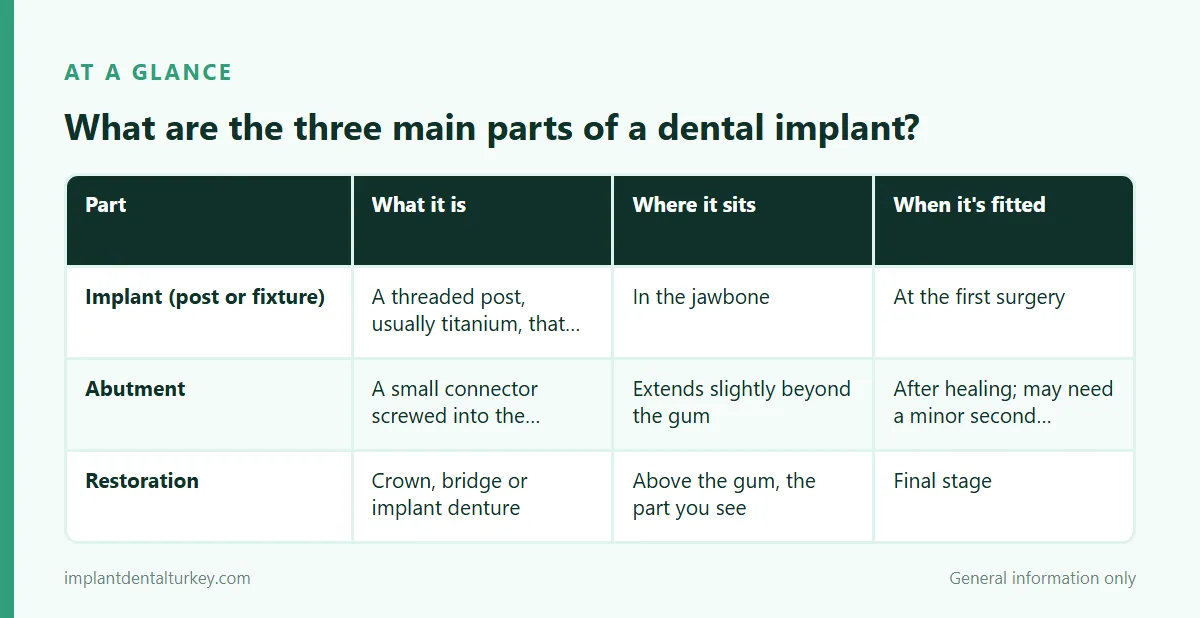
What are the three main parts of a dental implant?
| Part | What it is | Where it sits | When it’s fitted |
|---|---|---|---|
| Implant (post or fixture) | A threaded post, usually titanium, that replaces the tooth root | In the jawbone | At the first surgery |
| Abutment | A small connector screwed into the implant | Extends slightly beyond the gum | After healing; may need a minor second surgery |
| Restoration | Crown, bridge or implant denture | Above the gum, the part you see | Final stage |
This three-part description comes from Cleveland Clinic. Cork University Dental School and Hospital describes the implant itself as a false metal root, usually titanium, screwed into the jawbone and acting as an anchor for crowns, bridges or denture attachments.
What is the implant post made of?
Cleveland Clinic says most implants are titanium, some are ceramic, and both materials are considered safe and biocompatible. The post is threaded so it can be screwed into a hole prepared in the bone. Over three to nine months, the jawbone fuses to it, a process called osseointegration.
What does the abutment do?
The abutment links the implant under the gum to the visible tooth above it. Cleveland Clinic notes that fitting the abutment and final restoration takes about an hour and may require a second minor surgery. In a two-stage approach, Cork University Dental School describes a smaller second operation, after about four to six months of healing, to place an extension that shows above the gum so the gum can heal around it.
Abutments are held in with a screw. A review by Krishnan and colleagues in the Journal of the Indian Prosthodontic Society names abutment screw loosening as the second most common cause of failure of implant-supported restorations, which is why a wobbly crown should be checked promptly.
What’s a healing cap?
Colgate explains that after the implant has fused with the bone, the dentist may place a healing cap to help the gum heal, usually for around two weeks, before the abutment is fitted. It’s a temporary part and is removed later.
What kinds of restoration can go on implants?
- Single crown: one implant supports one crown (Cleveland Clinic).
- Implant bridge: two or more implants support a bridge replacing three or more teeth.
- Full arch: usually four to six implants support a full arch, either fixed or as a snap-on denture.
Cleveland Clinic gives a typical lifespan of around 15 years for crowns and bridges, while the implant itself can often last a lifetime with good care. Our article on types of dental crowns in NZ covers crown materials.
Why does this matter for your quote?
- Check whether the price includes the implant, abutment and crown, or only some of them.
- Ask whether a bone graft or healing cap stage is included.
- Ask what material the crown and abutment are made of.
- Ask which implant system is used, so another dentist can maintain it later.
Our guide to dental implant costs in New Zealand explains how these parts add up.
Sources
- Cleveland Clinic, Dental Implants
- Cork University Dental School and Hospital, Patient Information Leaflet: Implant Surgery
- Colgate, Single-Tooth Implants: What to Expect
- Krishnan V et al., Management of Abutment Screw Loosening, J Indian Prosthodont Soc, 2014
This article is general information and is not a substitute for advice from your own dentist.