What Is Bone Grafting for Dental Implants?
Why some people need a graft before an implant, and how it changes the timeline.
Edited and fact-checked by our editorial team.

What is bone grafting for dental implants? It is a minor surgical procedure that adds bone or bone-substitute material to the jaw where bone has thinned, so there is enough to hold an implant. The graft acts as a scaffold for new bone and needs at least three months to heal.
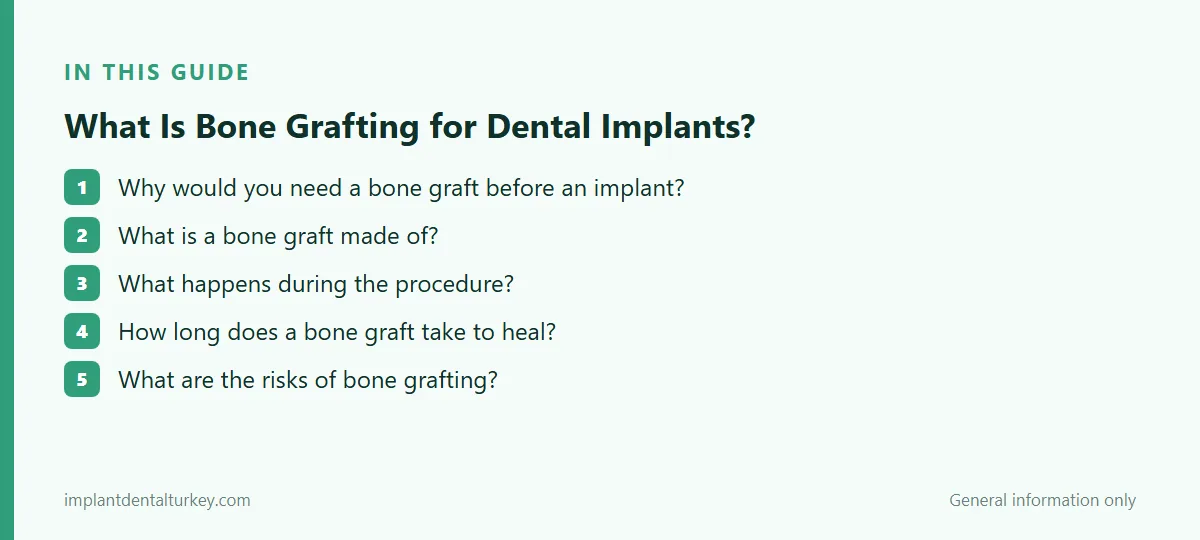
Not everyone needs a graft, but it is worth understanding before your assessment. This guide covers why grafts are needed, the types of material, what the procedure involves and how it changes your treatment timeline.
Why would you need a bone graft before an implant?
An implant needs enough healthy jawbone around it to fuse and stay stable. Cleveland Clinic lists adequate jawbone as a requirement, and Cork University Dental School and Hospital’s patient leaflet says some people don’t have enough good-quality bone, but it may be possible to add new bone to the jaw so implants can be placed.
Cleveland Clinic lists common reasons for grafting, including:
- filling an empty tooth socket after an extraction;
- increasing the width and volume of the jawbone;
- lifting the sinus floor in the upper jaw (a sinus lift) to make room for an implant;
- rebuilding bone lost to gum disease or trauma.
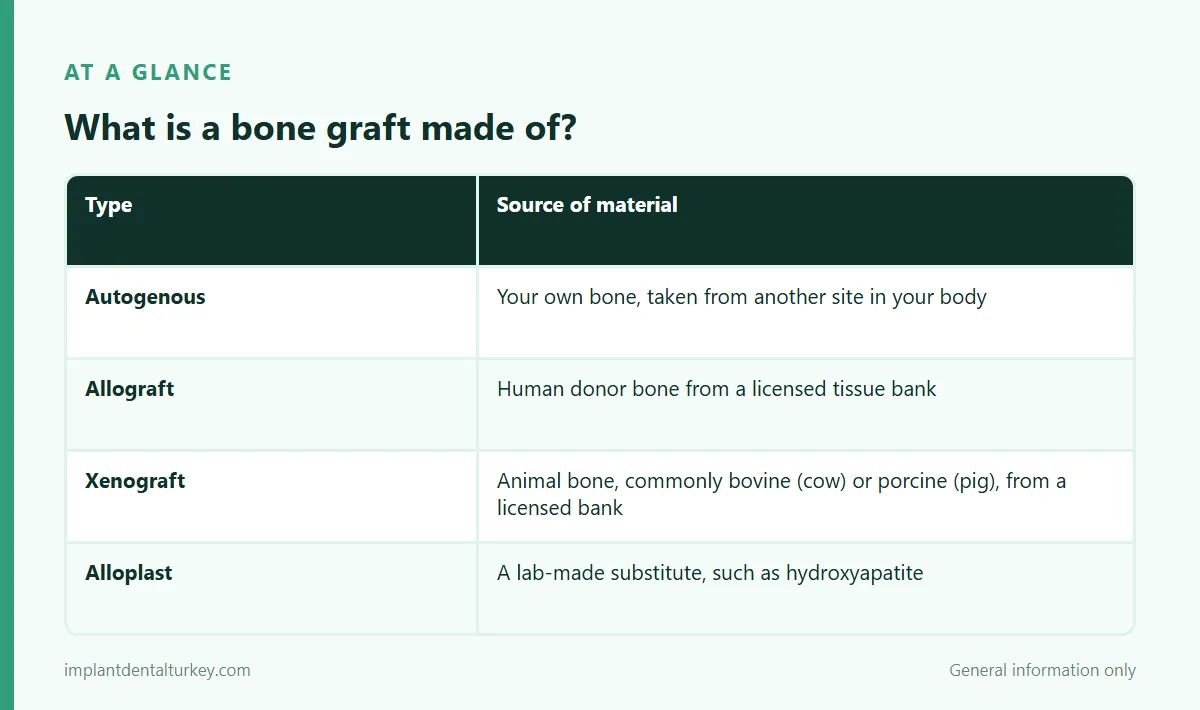
What is a bone graft made of?
| Type | Source of material |
|---|---|
| Autogenous | Your own bone, taken from another site in your body |
| Allograft | Human donor bone from a licensed tissue bank |
| Xenograft | Animal bone, commonly bovine (cow) or porcine (pig), from a licensed bank |
| Alloplast | A lab-made substitute, such as hydroxyapatite |
All of these are described by Cleveland Clinic. Ask your surgeon which type they recommend for you and why. Cleveland Clinic notes that providers place about 2.2 million bone grafts a year worldwide.
What happens during the procedure?
- The gums are numbed with local anaesthetic; sedation may be offered.
- A small incision is made and the gum is moved aside to expose the bone.
- The area is cleaned, the graft material is placed, and it is covered with a protective membrane.
- The gum is repositioned and stitched closed.
Cleveland Clinic describes the procedure as relatively minor, with most people reporting little to no pain afterwards.
How long does a bone graft take to heal?
- First week: initial recovery takes about a week. Tenderness, swelling and bruising usually fade within one to two weeks.
- Graft healing: at least three months; a large graft may take nine to 12 months (Cleveland Clinic). Colgate gives a range of 4 to 12 months before the implant.
- Implant window: once healed, Cleveland Clinic advises placing the implant within six to 12 months, as the graft may otherwise start to shrink and lose density.
Small sand-like grains of graft material can come out in the first few days, which is usually normal. A large amount should be reported to your provider. See our guide on how long dental implants take in NZ for the full timeline.
What are the risks of bone grafting?
Cleveland Clinic lists anaesthesia complications, infection, nerve damage and severe bleeding as possible risks. Signs a graft may be failing include pain or swelling that worsens after the first week, pus or drainage, gum recession, and no improvement in bone volume. Smokers and people with certain medical conditions have a higher chance of failure. Contact your provider if you have a fever of 38.3°C or higher, increasing swelling, pus or severe pain.
How do you look after a graft site?
- Use ice on the outside of the jaw and keep your head elevated.
- Eat soft foods and take medicines as prescribed.
- Avoid alcohol for at least two weeks.
- Avoid exercise and heavy lifting for at least 48 hours.
- Avoid vigorous spitting or swishing, and avoid smoking or vaping.
These steps all come from Cleveland Clinic’s graft aftercare guidance; follow your own surgeon’s instructions if they differ. If cost is a concern, our article on dental implant costs in New Zealand covers what can add to the total.
Sources
- Cleveland Clinic, Dental Bone Graft
- Cleveland Clinic, Dental Implants
- Colgate, Single-Tooth Implants: What to Expect
- Cork University Dental School and Hospital, Patient Information Leaflet: Implant Surgery
This article is general information and is not a substitute for advice from your own dentist.