Is a Loose Dental Implant an Emergency? How to Triage It
Crown, screw or implant: what a wobble may mean and how quickly to act.
Edited and fact-checked by our editorial team.
Is a loose dental implant an emergency? It needs prompt dental attention, usually within days, rather than emergency services on its own. The crown or the abutment screw may have loosened, which a dentist can often re-tighten. Movement of the implant itself, or swelling, pus or fever, is more serious.
A wobble is worrying, and it is tempting to wait and see. Waiting tends to make a loose screw looser. Here’s how to tell what might be moving, what counts as urgent, and what to do until you’re seen.
What could be loose?
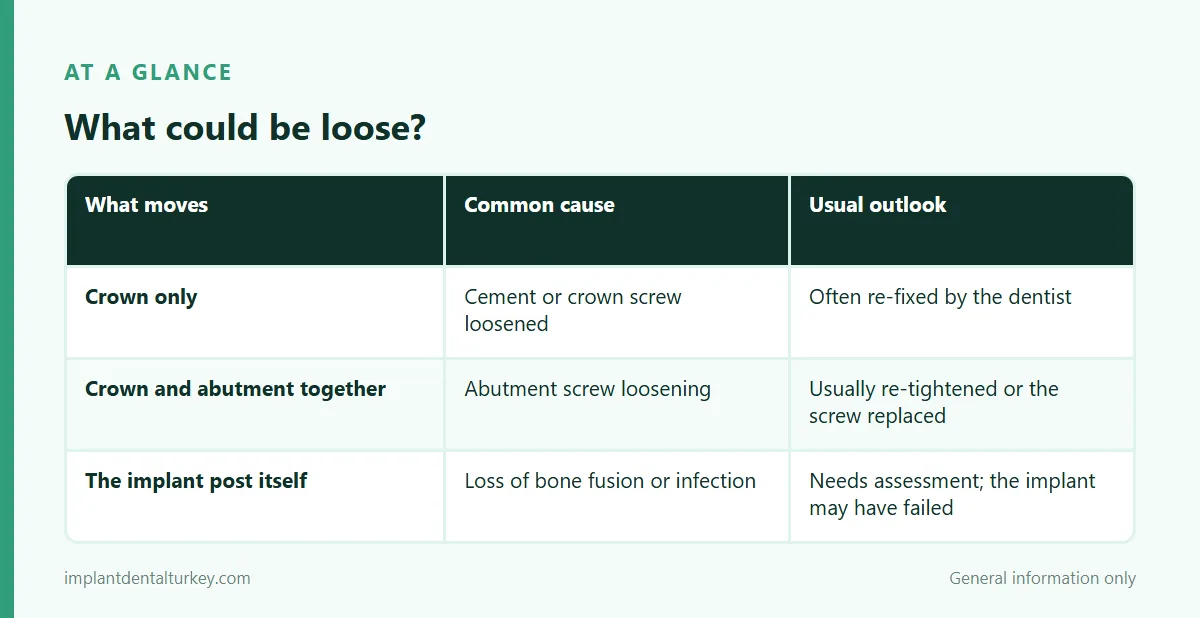
Cleveland Clinic describes three parts to an implant: the threaded post in the jawbone, the abutment that screws into it, and the crown or other restoration on top. Any of these can be the source of movement.
| What moves | Common cause | Usual outlook |
|---|---|---|
| Crown only | Cement or crown screw loosened | Often re-fixed by the dentist |
| Crown and abutment together | Abutment screw loosening | Usually re-tightened or the screw replaced |
| The implant post itself | Loss of bone fusion or infection | Needs assessment; the implant may have failed |
A review in the Journal of the Indian Prosthodontic Society (Krishnan and colleagues) describes abutment screw loosening as the second most common cause of failure of implant-supported restorations, after loss of the bond between implant and bone. It is more common with single-implant crowns and on molars.
When is a loose implant urgent?
Cleveland Clinic lists warning signs to contact your dentist about, including a loose or wobbly implant, bleeding or swollen gums, pus around the implant, fever, and swollen lymph nodes in the neck with other symptoms. A practical way to triage:
- Book promptly (within days): crown moves slightly, no pain, no swelling.
- Call your dentist the same day: movement with pain, bleeding, swelling, or pus.
- Seek emergency care: facial swelling that affects breathing, swallowing or opening your eyes, heavy bleeding that won’t stop, or a facial injury. These need emergency department care rather than a dental appointment. Health New Zealand gives similar advice: go to your hospital’s emergency department for a serious injury affecting your mouth, teeth or gums, and get to an after-hours dentist if the pain is bad or the injury appears serious.
If you’re in New Zealand and can’t reach your own dentist, our guide to emergency dentists in New Zealand explains your options. Health NZ notes that people with a Community Services Card may be able to get emergency dental care, such as pain relief, from public hospitals or Health NZ-contracted dentists, though they may still pay part of the cost.
Why shouldn’t you wait?
The Krishnan review explains that once a screw starts loosening, everyday biting loads tend to loosen it further. In cemented crowns, the crown may be damaged when the dentist removes it to reach the screw, which adds cost and delay. Getting it checked early gives the best chance of a simple fix.
If the cause is biological rather than mechanical, timing matters too. The British Society of Periodontology explains that gum disease around implants starts with bleeding and can progress to loss of supporting bone and, eventually, the implant.
What will the dentist do?
- Examine and X-ray to see what is moving. In the case described by Krishnan and colleagues, an X-ray showed a gap between the implant and abutment.
- Re-tighten or replace the screw if the abutment has loosened, using a calibrated torque wrench.
- Re-fix or remake the crown if needed.
- Treat infection if there are signs of gum or bone problems around the implant.
What to do until your appointment
- Avoid biting hard foods on that tooth. If the implant or crown was damaged in an accident or injury, Healthify notes that ACC can help with the cost of dental treatment, and your dentist will help you fill out the claim form.
- Try not to wiggle it with your tongue or fingers, since movement is what loosens a screw further.
- Keep brushing gently around it to keep plaque down.
- If the crown comes off, keep it safe and take it to the dentist.
If your implant was placed overseas, plan how you’d get it looked at in New Zealand before you need to. Our article on choosing a dentist in Turkey from NZ covers follow-up arrangements.
Sources
- Cleveland Clinic, Dental Implants
- Krishnan V, Thomas CT, Sabu I, Management of Abutment Screw Loosening: Review of Literature and Report of a Case, J Indian Prosthodont Soc, 2014
- NHS (UK), How to find an emergency or urgent dentist appointment
- NHS 111 Wales, Lost filling or crown
- Health NZ, Dental care
- British Society of Periodontology and Implant Dentistry, Looking after your implants
- Health New Zealand | Te Whatu Ora, Dentists and emergency dental care
- Healthify, Dental health support
This article is general information and is not a substitute for advice from your own dentist.