Do Dental Implants Prevent Bone Loss? What the Evidence Says
How implants help preserve jawbone, and how to stop bone loss around an implant.
Edited and fact-checked by our editorial team.

Do dental implants prevent bone loss? They help. Cleveland Clinic says implants help preserve jawbone after tooth loss, which conventional dentures resting on the gums do not. But implants are not immune: inflammation around an implant, called peri-implantitis, can itself destroy the supporting bone.
Bone loss is one of the less visible consequences of losing teeth, and it shapes many of the decisions in tooth replacement. Here is what happens to the jaw after a tooth goes, how each replacement option affects it, and how to protect the bone around an implant once it is in.
What happens to the jawbone after a tooth is lost?
Cleveland Clinic explains that the jawbone shrinks after tooth loss. Over time, this can contribute to facial changes such as sunken cheeks. It is also why dentures that fitted well at first can loosen: Cleveland Clinic recommends a denture reline every one to two years, or sooner if the fit changes.
Bone loss also affects whether an implant is possible later. Cleveland Clinic notes that implants need enough healthy jawbone, and that bone grafts may be needed where bone has been lost. In the upper back jaw, the American Academy of Periodontology explains that limited bone and closeness to the sinus can mean a sinus lift is needed before implants can be placed.
How do implants help preserve bone?
An implant is a post placed into the jawbone, which fuses with the bone over roughly three to nine months, according to Cleveland Clinic. Because it sits in the bone like a tooth root, Cleveland Clinic says implants help preserve jawbone and reduce the sunken appearance that can follow bone loss. Implants can also be used to stabilise loose dentures.
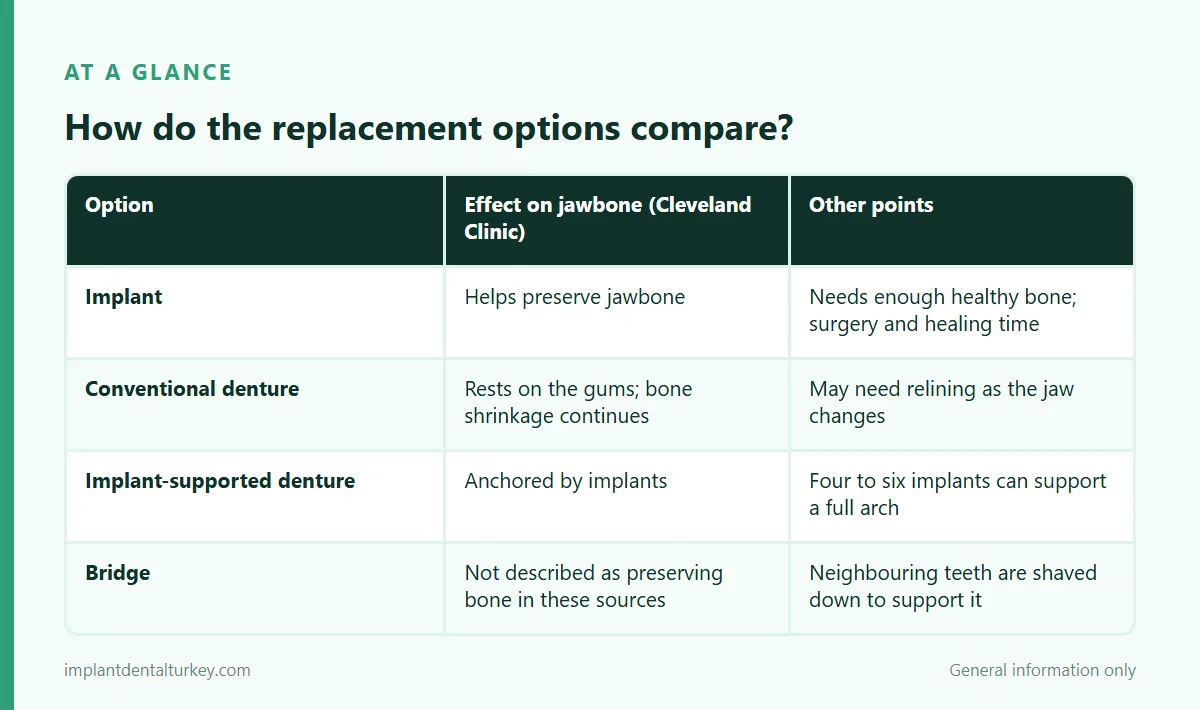
How do the replacement options compare?
| Option | Effect on jawbone (Cleveland Clinic) | Other points |
|---|---|---|
| Implant | Helps preserve jawbone | Needs enough healthy bone; surgery and healing time |
| Conventional denture | Rests on the gums; bone shrinkage continues | May need relining as the jaw changes |
| Implant-supported denture | Anchored by implants | Four to six implants can support a full arch |
| Bridge | Not described as preserving bone in these sources | Neighbouring teeth are shaved down to support it |
Can you lose bone around an implant?
Yes. A 2024 review in Dentistry Journal describes peri-implantitis as an inflammatory condition around an implant that leads to loss of the supporting bone. Signs include bleeding and pus around the implant, deepening pockets and bone loss visible on X-rays, and in advanced cases the implant can loosen. The review links the condition to smoking, a history of gum disease, poor plaque control, uncontrolled diabetes and excess cement left around the crown, and notes it tends to appear after implants have been in place for some years.
How can you protect the bone around an implant?
- Clean around it daily. The Scottish Dental Clinical Effectiveness Programme recommends a toothbrush, interdental brushes and floss for a single implant crown, and interdental brushes rather than floss where rough implant threads are exposed.
- Keep maintenance visits. The Dentistry Journal review recommends regular professional checks of the tissues around implants.
- Stop smoking. Cleveland Clinic notes smoking or vaping can disrupt healing, and the review links smoking to peri-implantitis.
- Manage diabetes with your GP.
- Act early. Cleveland Clinic advises contacting your dentist about bleeding or swollen gums, pus or an implant that feels loose.
Does timing matter?
Because the jaw keeps changing after tooth loss, ask your dentist how long you can safely wait before replacing a tooth, and whether waiting could mean a bone graft later. For more on planning, see our step-by-step guide to implant treatment in NZ and our comparison of implants and bridges.
Sources
- Cleveland Clinic, Dental Implants
- Cleveland Clinic, Dentures
- Ting M, Suzuki JB. Peri-Implantitis. Dentistry Journal, 2024
- Scottish Dental Clinical Effectiveness Programme, Implant Oral Hygiene
- American Academy of Periodontology, Sinus Augmentation
This article is general information and is not a substitute for advice from your own dentist.