How Much Bone Is Needed for a Dental Implant?
Bone height, width and grafting: why what's under the gum shapes your implant plan.
Edited and fact-checked by our editorial team.

How much bone is needed for a dental implant? There’s no single figure, but a dental review gives about 10 mm of bone height as the minimum for predictable success in good-quality bone, with a 2 mm margin from nerves. If bone is short, grafting can add it.
Bone is often the hidden variable in an implant quote. Two people missing the same tooth can face very different treatment plans because of what’s under the gum. Here’s what dentists look at, what happens when bone is short, and how it affects your budget.
Why does bone quantity matter?
An implant is a threaded post that the jawbone fuses to over three to nine months, according to Cleveland Clinic, which names enough healthy bone as the main requirement for implants. Cork University Dental School and Hospital says there must be enough bone to hold an implant securely, and that some people don’t have enough good-quality bone.
What measurements do dentists consider?
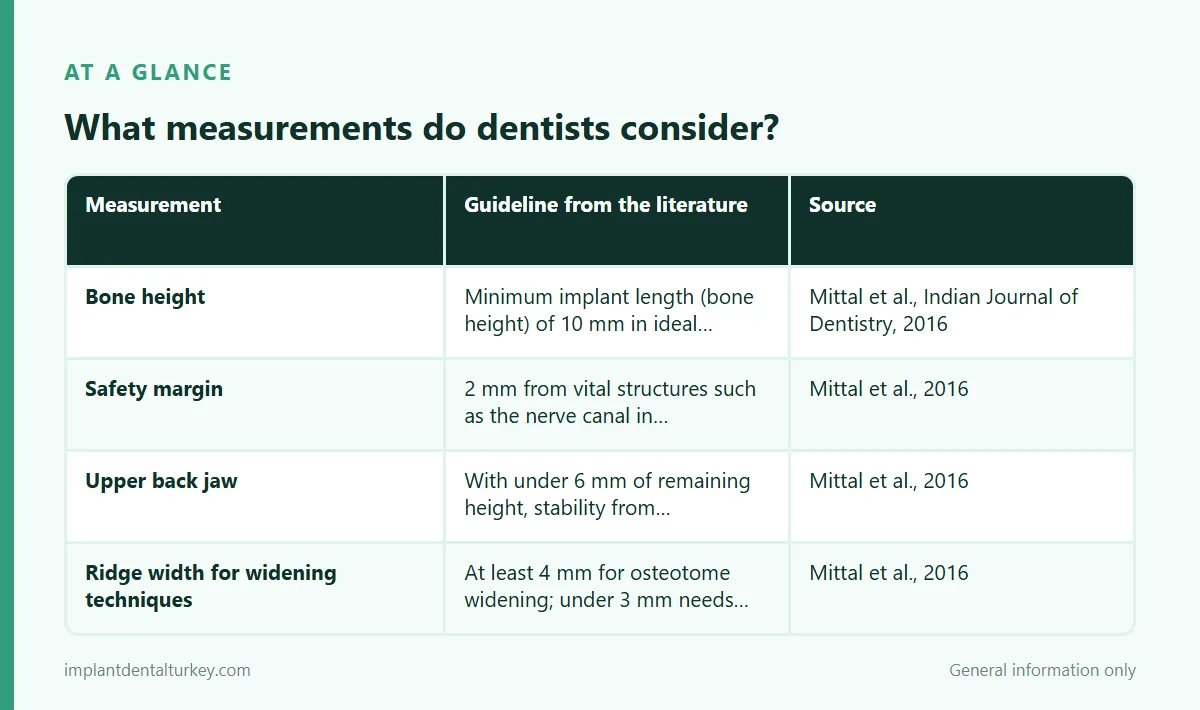
| Measurement | Guideline from the literature | Source |
|---|---|---|
| Bone height | Minimum implant length (bone height) of 10 mm in ideal bone density for predictable success | Mittal et al., Indian Journal of Dentistry, 2016 |
| Safety margin | 2 mm from vital structures such as the nerve canal in the lower jaw | Mittal et al., 2016 |
| Upper back jaw | With under 6 mm of remaining height, stability from the simpler crestal sinus approach is unproven | Mittal et al., 2016 |
| Ridge width for widening techniques | At least 4 mm for osteotome widening; under 3 mm needs ridge splitting first | Mittal et al., 2016 |
These are guideline figures, not hard cut-offs. Bone density, implant design and the exact site all change the picture, which is why your dentist plans from an assessment of your own jaw rather than a general rule.
What if there isn’t enough bone?
- Bone graft: Cleveland Clinic describes grafts that add bone where it’s thin or missing, using your own bone, donor bone, animal bone or a synthetic material. A graft needs at least three months to heal, and a large graft nine to 12 months.
- Sinus lift: the American Academy of Periodontology explains the upper back jaw often lacks bone and sits close to the sinus. A sinus lift raises the sinus floor and adds graft material; bone usually needs four to 12 months before implants.
- Ridge widening or splitting: techniques described by Mittal and colleagues can widen a narrow ridge by 2 to 5 mm.
See our guide to how long dental implants take in NZ for how these steps stretch the timeline.
Why does bone get lost?
Cleveland Clinic explains that the jawbone gradually shrinks after tooth loss, and dentures don’t prevent it. The American Academy of Periodontology also lists bone loss from gum disease or tooth loss as a reason for insufficient bone in the upper jaw. That’s one reason timing matters: the longer a gap is left, the more planning may be needed later.
How does bone affect the cost?
Every extra procedure adds to the bill. Health NZ notes there’s no fixed or recommended fee structure for private dentists in New Zealand, so ask for an itemised quote that shows:
- the scans used for planning;
- any bone graft or sinus lift, with materials;
- the implant, abutment and crown separately;
- extra appointments needed for graft healing checks.
Our article on dental implant costs in New Zealand explains the other price components.
Questions to ask at your assessment
- How much bone do I have at the site, in height and width?
- Do I need a graft, a sinus lift or neither?
- Could a shorter or narrower implant avoid grafting in my case?
- How much time and cost does the bone work add?
Sources
- Mittal Y, Jindal G, Garg S, Bone manipulation procedures in dental implants, Indian Journal of Dentistry, 2016
- Cleveland Clinic, Dental Implants
- Cleveland Clinic, Dental Bone Graft
- Cleveland Clinic, Dentures
- American Academy of Periodontology, Sinus Augmentation
- Cork University Dental School and Hospital, Patient Information Leaflet: Implant Surgery
- Health NZ, Dental care
This article is general information and is not a substitute for advice from your own dentist.