Molar Teeth Replacement Cost: What Changes the Price
Options for replacing a back tooth and the extras that change the cost.
Edited and fact-checked by our editorial team.

Molar teeth replacement cost in NZ depends on the option (implant, bridge or partial denture), on extras such as a bone graft or sinus lift, and on the practice. Health New Zealand notes adult dental fees are set privately and vary, so get a written, itemised quote.
Molars do the heavy chewing, and losing one at the back of the mouth is easy to ignore at first. When you start pricing a replacement, though, the options and the hidden extras can be confusing. This guide explains what changes the cost for a back tooth specifically.
What are the options for replacing a missing molar?
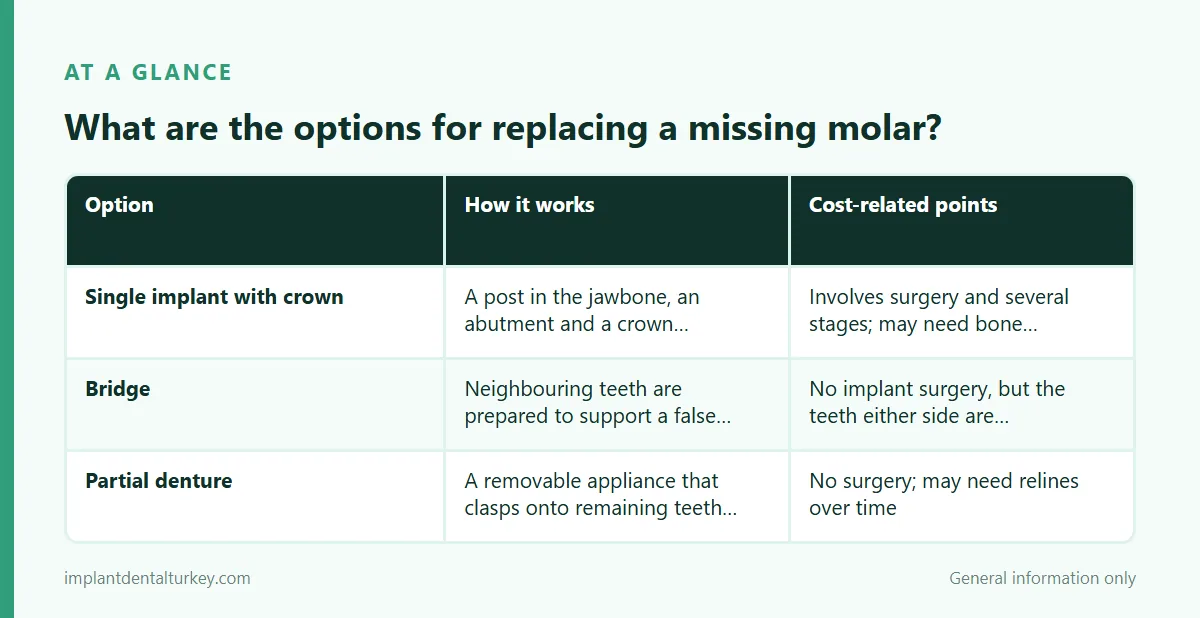
| Option | How it works | Cost-related points |
|---|---|---|
| Single implant with crown | A post in the jawbone, an abutment and a crown (Cleveland Clinic) | Involves surgery and several stages; may need bone grafting |
| Bridge | Neighbouring teeth are prepared to support a false tooth (Cleveland Clinic) | No implant surgery, but the teeth either side are shaved down |
| Partial denture | A removable appliance that clasps onto remaining teeth (Cleveland Clinic) | No surgery; may need relines over time |
Cleveland Clinic notes bridges work best for one to three missing teeth in a row, and that implants do not involve the neighbouring teeth, unlike a bridge.
Why can upper molar implants cost more?
The back of the upper jaw is a special case. The American Academy of Periodontology describes the upper back jaw as one of the most difficult areas for implants, because of limited bone and closeness to the sinus. Colgate explains that when there is not enough bone height, a sinus lift may be needed, with bone typically taking four to 12 months to develop before implants are placed. That adds a surgical step, extra materials and more time, all of which can appear on a quote.
What should a molar replacement quote include?
Ask for every stage to be itemised:
- Consultation, X-rays and any 3D scans
- Extraction, if the tooth is still present
- Bone grafting or a sinus lift, if needed
- The implant placement surgery
- The abutment and crown, which Cleveland Clinic notes are fitted after a healing period of about three to nine months
- Review appointments and any temporary tooth
Health New Zealand suggests comparing fees between dentists. Comparing like for like is only possible when each quote lists the same stages.
Is it cheaper to save the molar?
Sometimes the alternative to replacement is treating the tooth you have, for example with root canal treatment and a crown. Costs vary by practice. Note for budgeting: Work and Income’s dental help, which covers up to $1,000 (Work and Income, checked October 2026) a year for immediate and essential treatment for eligible people, specifically excludes molar root canal treatment and cast restorations. ACC can contribute if the molar was damaged in an accident, but its guide notes crowns, bridges and root canal treatment need prior approval and there is usually a co-payment.
How can you plan for the long-term cost?
- Cleveland Clinic says an implant post can last a lifetime with good care, while the crown typically lasts about 15 years.
- Removable dentures have an average lifespan of seven to 10 years and may need relining every one to two years, according to Cleveland Clinic.
- Factor in maintenance visits for whichever option you choose.
For broader pricing information, see our guides to dental implant costs in New Zealand and bridges versus implants in NZ.
Sources
- Health New Zealand, Dentists
- Cleveland Clinic, Dental Implants
- Cleveland Clinic, Dentures
- American Academy of Periodontology, Sinus Augmentation
- Colgate, What Is a Sinus Lift?
- Work and Income, Dental treatment
- ACC, Dental injury guide (ACC7672)
This article is general information and is not a substitute for advice from your own dentist.