Dental Implant Crown: The Part You Actually See
How the crown, abutment and post fit together, plus materials, lifespan and cleaning.
Edited and fact-checked by our editorial team.

A dental implant crown is the visible, tooth-shaped cap that sits on top of an implant. It attaches to a small connector called an abutment, which in turn screws into the titanium or ceramic post in your jawbone. The crown is the part you chew with and see in the mirror.
People often talk about “getting an implant” as one thing, but in practice it is three components made and fitted at different stages. Knowing which part is which makes treatment plans, quotes and maintenance advice from your dentist far easier to follow, especially when you are comparing options in New Zealand.
What are the three parts of an implant?
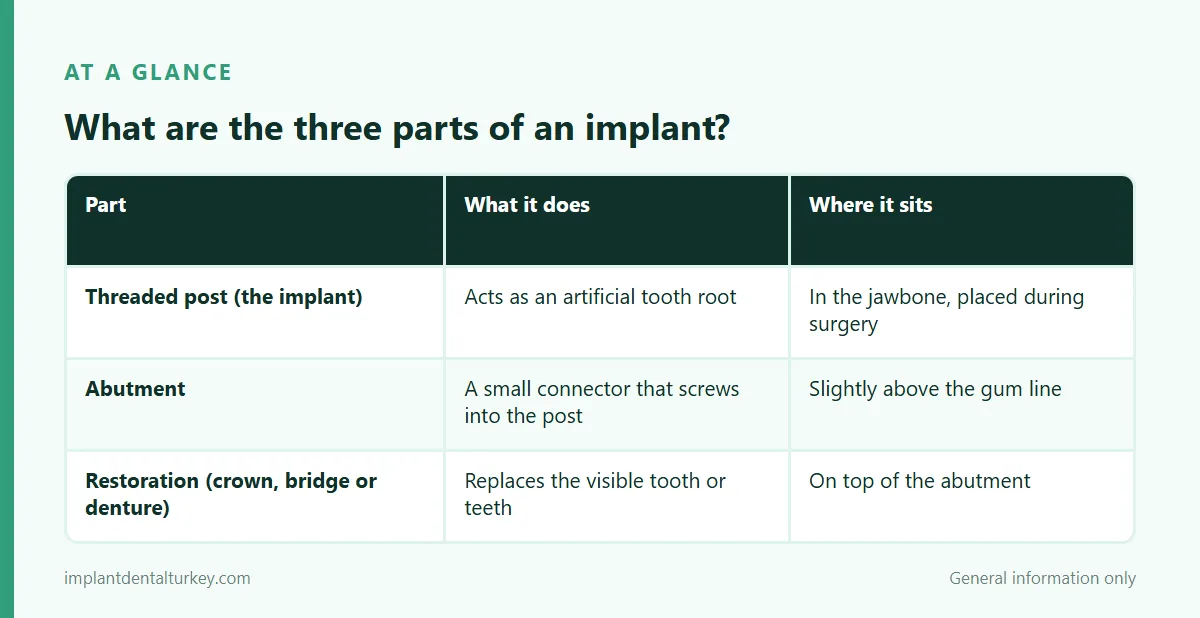
Cleveland Clinic describes an implant restoration as three pieces working together:
| Part | What it does | Where it sits |
|---|---|---|
| Threaded post (the implant) | Acts as an artificial tooth root | In the jawbone, placed during surgery |
| Abutment | A small connector that screws into the post | Slightly above the gum line |
| Restoration (crown, bridge or denture) | Replaces the visible tooth or teeth | On top of the abutment |
For a single missing tooth, one implant usually supports one crown. Cleveland Clinic notes that two or more implants can support a bridge replacing three or more teeth, and four to six implants can support a full arch.
When is the crown fitted?
The crown does not go on straight away in a standard treatment plan. After the post is placed, the jawbone needs time to fuse with it, a process called osseointegration. Cleveland Clinic puts this healing period at roughly three to nine months, depending on how quickly your body heals. Once the implant is stable, the abutment and final crown are attached. Cleveland Clinic says this step takes about an hour and may involve a second minor procedure to expose the implant.
Not every treatment plan follows exactly this sequence, and your dentist will explain the timing that suits your situation. Our article on same day dental implants in NZ looks at when faster options are considered. For the full timeline from consultation to final tooth, see how long dental implants take in NZ.
What materials are implant crowns made from?
Implant crowns use the same families of materials as crowns on natural teeth. Cleveland Clinic’s overview of crowns lists the main options and their trade-offs:
- All-ceramic or porcelain: the most natural appearance and suitable for people with metal allergies. Zirconia versions are very durable and gentler on opposing teeth.
- Porcelain-fused-to-metal: metal strength with a tooth-coloured surface, though the porcelain layer can chip.
- Metal (such as gold alloys): rarely chips and lasts well, but the colour limits it mainly to back teeth.
- All-resin: less expensive but more fragile, and often used for temporary crowns.
Your dentist will weigh where the tooth is, how hard you bite, and how important colour matching is. Our guide to zirconia versus porcelain crowns in NZ looks at the materials side by side.
How long does an implant crown last?
It helps to separate the implant from the crown. Cleveland Clinic says the implant itself can last a lifetime with good oral hygiene and regular dental visits, while crowns and bridges on implants last about 15 years on average before they may need replacing. Wear, chips and changes in the surrounding gum can all mean a crown is remade while the post underneath stays put.
How do you look after a crown on an implant?
The crown is artificial, but the gum and bone around an implant still need daily care. The Scottish Dental Clinical Effectiveness Programme (SDCEP) advises that a single implant crown can be cleaned much like a natural tooth, using:
- A toothbrush, with a rechargeable electric brush an option if a manual brush is hard to use well.
- Interdental brushes that fit snugly without the wire rubbing the crown.
- Dental floss or implant floss, used gently and not forced below the gum margin.
SDCEP adds that where rough implant threads are exposed, interdental brushes are preferred, because floss fibres can shed and have been linked to a higher risk of peri-implant disease. Cleveland Clinic recommends contacting your dentist if an implant feels loose, or if you notice bleeding or swollen gums, pus or a fever.
Sources
- Cleveland Clinic, Dental Implants
- Cleveland Clinic, Dental Crowns
- Scottish Dental Clinical Effectiveness Programme, Implant Oral Hygiene
This article is general information and is not a substitute for advice from your own dentist.