Do You Get Put to Sleep for Dental Implants?
Local, sedation or general anaesthetic: what each means on the day of implant surgery.
Edited and fact-checked by our editorial team.
Do you get put to sleep for dental implants? Usually not. Most implant surgery is done under local anaesthetic, which numbs the area while you stay awake. Sedation is an option for nervous patients, and a general anaesthetic, where you’re fully asleep, is used when the surgeon decides it’s necessary.
If you’re anxious about surgery, knowing your choices in advance makes it easier to talk to your dentist. Here’s how the three main options compare, and what each means for the day itself.
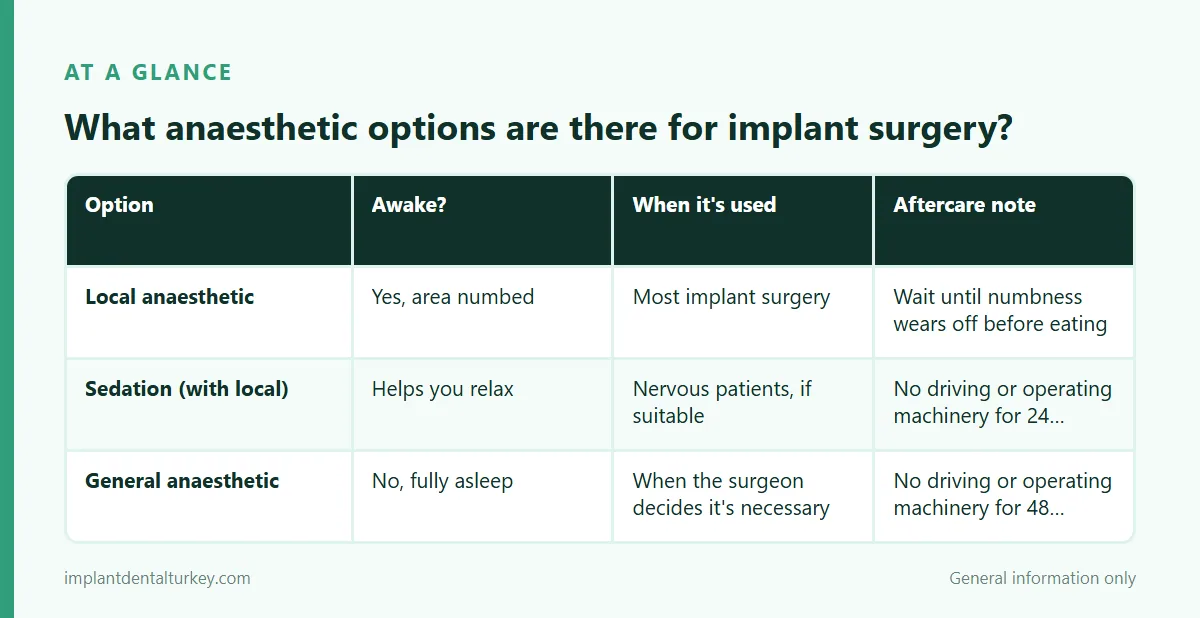
What anaesthetic options are there for implant surgery?
Cork University Dental School and Hospital’s implant surgery leaflet describes three approaches: local anaesthetic, which is usual; sedation, which some nervous patients have to help them relax; and, when necessary, a general anaesthetic so you’re completely asleep. Cleveland Clinic similarly says anaesthesia numbs the gums and sedation is optional, and that you shouldn’t feel pain during surgery.
| Option | Awake? | When it’s used | Aftercare note |
|---|---|---|---|
| Local anaesthetic | Yes, area numbed | Most implant surgery | Wait until numbness wears off before eating |
| Sedation (with local) | Helps you relax | Nervous patients, if suitable | No driving or operating machinery for 24 hours after IV sedation |
| General anaesthetic | No, fully asleep | When the surgeon decides it’s necessary | No driving or operating machinery for 48 hours |
The driving restrictions come from the Cork University Dental School leaflet. Cleveland Clinic advises not eating until local anaesthetic has worn off, to avoid biting numb tissue.
What does local anaesthetic feel like?
The Cork leaflet describes it as an injection in your mouth that makes the area completely numb. Once numb, a cut is made in the gum, a hole is prepared in the bone and the implant is placed, then the gum is stitched. You’ll be aware of what’s happening, but the area shouldn’t be painful. Afterwards, pain and swelling are expected, are usually worst in the first few days, and can take a couple of weeks to settle fully, according to the same leaflet.
Who might choose sedation?
Cork University Dental School describes sedation as an option for nervous patients, which your surgeon will discuss to see whether it suits you. Cleveland Clinic notes that sedation can also be added to local anaesthetic for bone grafting, which is sometimes part of implant treatment. Points to raise if you’re considering it:
- how anxious you feel about dental treatment, honestly described;
- any medical conditions and medicines you take;
- whether you can arrange someone to take you home, since you can’t drive for 24 hours after IV sedation.
Our guide to sedation dentistry in New Zealand explains the types available here in more detail.
Is a general anaesthetic ever needed?
Sometimes. Cork University Dental School says it may be necessary to do the surgery under general anaesthetic, and that you can’t drive for 48 hours afterwards. Ask where it would take place and what preparation is needed. In New Zealand, Health NZ notes that some disabled people, or people with conditions such as mouth cancer, may be referred to hospital for dental treatment.
Questions to ask your implant dentist
- Which anaesthetic do you recommend for my procedure, and why?
- Is sedation available here, and who monitors me during it?
- What will I need to do before the appointment (eating, medication)?
- How long will I need someone with me afterwards?
- What pain relief should I have ready at home?
If pain is your main worry, our article on whether dental treatments are painful in NZ may also help.
Sources
- Cork University Dental School and Hospital, Patient Information Leaflet: Implant Surgery
- Cleveland Clinic, Dental Implants
- Cleveland Clinic, Dental Bone Graft
- Cleveland Clinic, What to Eat After Oral Surgery
- Health NZ, Dental care
This article is general information and is not a substitute for advice from your own dentist.