Can Dental Implants Be Removed and Replaced With Dentures?
Implant removal, what it leaves behind, and the options that follow.
Edited and fact-checked by our editorial team.

Can dental implants be removed and replaced with dentures? Yes. A dentist or oral surgeon can remove an implant, usually when it has failed or become infected, and the gap can then be filled with a denture, a bridge or, if the bone allows, a new implant. Removal leaves a bone defect, so the next step needs planning.
This question can come up when an implant is failing, when ongoing problems make someone want a simpler option, or when costs are a worry. Here’s what removal involves, why it’s done and what your options are afterwards.
Why are dental implants removed?
A 2019 review in Clinical and Experimental Dental Research (Solderer and colleagues) looked at the reasons and methods for removing failed implants. Key findings:
- peri-implantitis, infection of the gum and bone around the implant, was the main cause of late failure, at around 82% in one cited cohort;
- malpositioning, where an implant is in the wrong place, accounted for about 14% of removals in that cohort;
- implant fractures were rare, about 0.4% of implants in one study;
- early failures are usually loose and easy to remove, while late failures are often still partly fused to bone and harder to take out.
How is an implant removed?
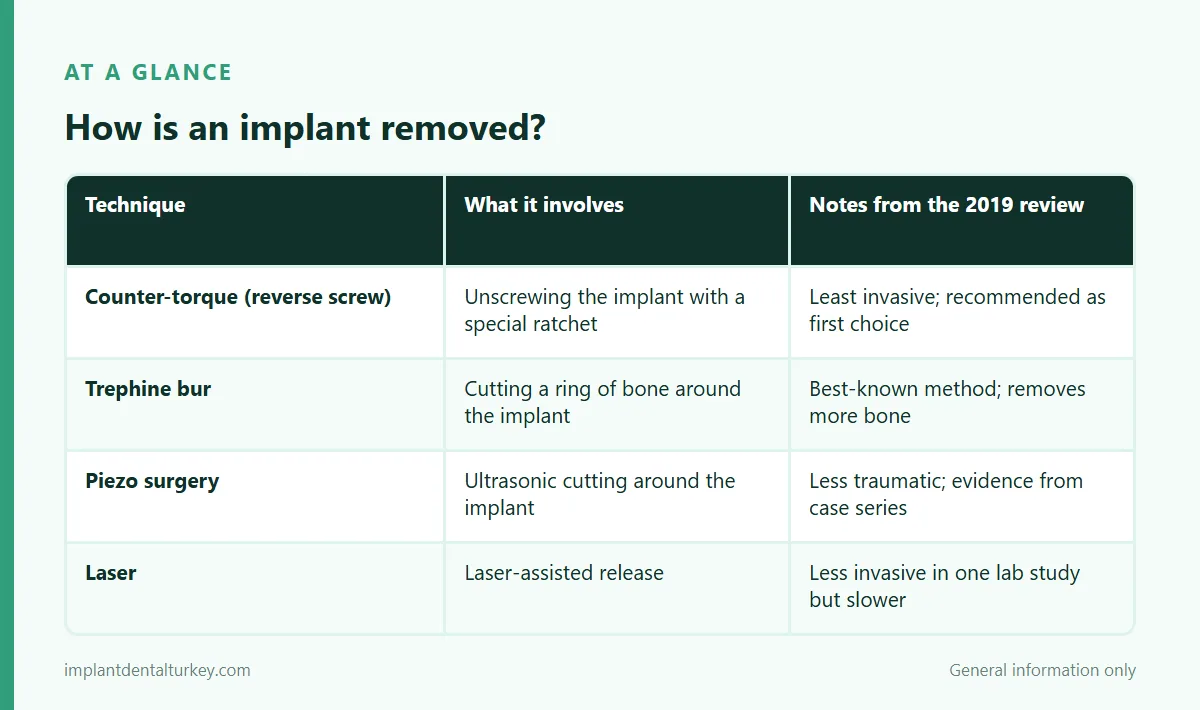
| Technique | What it involves | Notes from the 2019 review |
|---|---|---|
| Counter-torque (reverse screw) | Unscrewing the implant with a special ratchet | Least invasive; recommended as first choice |
| Trephine bur | Cutting a ring of bone around the implant | Best-known method; removes more bone |
| Piezo surgery | Ultrasonic cutting around the implant | Less traumatic; evidence from case series |
| Laser | Laser-assisted release | Less invasive in one lab study but slower |
The review notes that early failures are usually mobile and easy to remove, while partly fused implants are harder, so the method depends on the situation. Ask your surgeon which anaesthetic and technique they plan to use.
Can you switch to a denture after removal?
Yes. Once the site has healed, a denture can replace the missing teeth. Cleveland Clinic describes the options: a partial denture uses clasps on your remaining natural teeth, and a full denture rests on the gums. Be aware of the trade-offs Cleveland Clinic lists for conventional dentures: they can shift or slip, they don’t stop the jawbone shrinking after tooth loss, and they typically last seven to 10 years with relines every one to two years.
If you still have other healthy implants, a snap-in denture that clips onto them may be an alternative to a conventional denture. Our article on bridges vs implants in NZ covers another fixed option.
What about replacing the implant instead?
Sometimes that’s possible. The 2019 review reports that a new implant can occasionally be placed in the same session if the bone is adequate and there’s no infection, but larger defects need bone grafting first and a delayed implant. Survival of implants placed in previously failed sites ranged from 71% to 100% over about five years in the studies reviewed. Removal creates a defect at least as large as the failed implant, which is why the bone needs assessing first. See our guide on implant treatment timelines.
Questions to ask before deciding
- Why is the implant failing, and can it be treated rather than removed?
- Which removal technique would you use, and how much bone will be lost?
- Would a graft let me have another implant later?
- How would a denture fit with my remaining teeth or implants?
- What are the costs of each option, including future maintenance?
In New Zealand, if the problem followed an injury or treatment, Health NZ notes ACC may cover dental treatment, though you may still pay part of the cost.
Sources
- Solderer A et al., Removal of failed dental implants revisited: Questions and answers, Clinical and Experimental Dental Research, 2019
- Cleveland Clinic, Dentures
- Cleveland Clinic, Dental Implants
- Health NZ, Dental care
This article is general information and is not a substitute for advice from your own dentist.