Denture Implants in NZ: Snap-In and Fixed Options
How implant dentures work, how they compare and what to know about paying in NZ.
Edited and fact-checked by our editorial team.

Denture implants in NZ come in two main forms: a removable “snap-in” denture that clips onto implants, and a fixed implant-supported denture that only a dentist can remove. Both are more stable than a conventional denture. Adults usually pay privately, and Work and Income’s dental grant doesn’t cover dentures.
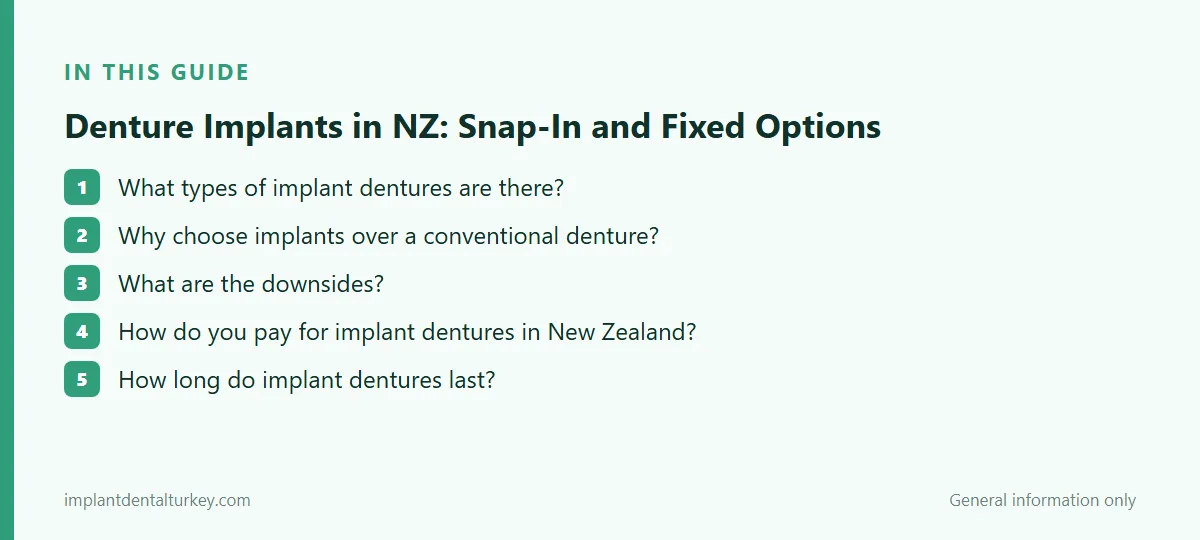
If a loose denture makes eating or speaking difficult, implants may be worth asking about. This guide explains the options, how they compare with a standard denture, and what to know about paying for them in New Zealand.
What types of implant dentures are there?
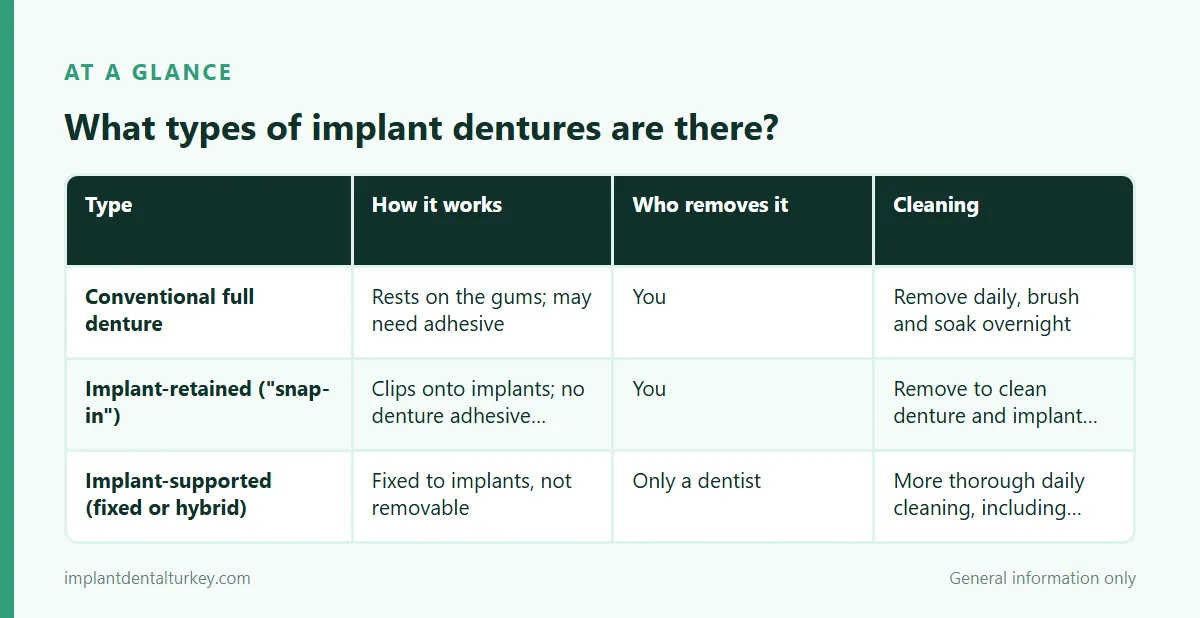
| Type | How it works | Who removes it | Cleaning |
|---|---|---|---|
| Conventional full denture | Rests on the gums; may need adhesive | You | Remove daily, brush and soak overnight |
| Implant-retained (“snap-in”) | Clips onto implants; no denture adhesive needed | You | Remove to clean denture and implant attachments |
| Implant-supported (fixed or hybrid) | Fixed to implants, not removable | Only a dentist | More thorough daily cleaning, including underneath |
These descriptions come from Cleveland Clinic’s guide to dentures. Cleveland Clinic’s implant guide adds that a full arch is usually supported by four to six implants, with either a non-removable or snap-on denture. For the fixed full-arch approach, our All-on-4 price guide for NZ goes into detail.
Why choose implants over a conventional denture?
- Stability: Cleveland Clinic says traditional removable dentures often shift, wobble or slip, while snap-in dentures are more stable.
- Bone: the jawbone gradually shrinks after tooth loss and dentures don’t prevent it, according to Cleveland Clinic, which says implants stimulate the jaw and help halt bone loss.
- Function: Cleveland Clinic lists better chewing, improved speech and stability for wobbly dentures among implant benefits.
What are the downsides?
- Cost: Cleveland Clinic notes implants are typically more expensive than dentures.
- Surgery and time: implants need surgery and three to nine months for the bone to fuse.
- Bone requirements: enough healthy jawbone is needed; a bone graft may be required.
- Cleaning: fixed implant dentures need more thorough daily cleaning, and the Scottish Dental Clinical Effectiveness Programme says people with implant bridges or dentures need personalised hygiene training.
- Short-term fit: Cork University Dental School notes an existing denture may not fit as well after implant surgery.
How do you pay for implant dentures in New Zealand?
Health NZ says adults pay privately for most dental services and that there’s no fixed or recommended fee structure for private dentists, so prices vary by practice and location. It suggests asking several dentists about fees.
Work and Income’s dental treatment help, up to $1,000 (Work and Income, checked October 2026) in a 52-week period for immediate and essential treatment, doesn’t cover dentures. Its page notes that recoverable assistance or an advance payment may be available for dentures instead. If you need dental treatment because of an injury, Health NZ notes ACC may cover it, though you may still pay part of the cost. Our articles on financing dental treatment in NZ and full mouth implant costs cover the numbers.
How long do implant dentures last?
Cleveland Clinic says implants themselves can often last a lifetime with good care, while dentures last at least seven years and conventional dentures typically seven to 10 years, with a reline every one to two years. The denture part of an implant denture will still need maintenance and eventual replacement.
Questions to ask your dentist
- Is a snap-in or fixed option better for my jaw and budget?
- How many implants do you recommend, and why?
- Will I need a bone graft?
- Can my current denture be adapted while I heal?
- What will maintenance cost each year?
Sources
- Cleveland Clinic, Dentures
- Cleveland Clinic, Dental Implants
- Health NZ, Dental care
- Work and Income, Dental treatment
- Scottish Dental Clinical Effectiveness Programme, Implant oral hygiene
- Cork University Dental School and Hospital, Patient Information Leaflet: Implant Surgery
This article is general information and is not a substitute for advice from your own dentist.