Gums Around Dental Implants: Normal Healing and Warning Signs
How the gum heals around an implant, the signs of trouble and the cleaning that helps.
Edited and fact-checked by our editorial team.

Healthy gums around dental implants don’t bleed when you brush. Bleeding, swelling or pus are warning signs of inflammation that can spread to the bone holding the implant. Daily cleaning, interdental brushes and regular professional checks are the best way to keep the gum around an implant healthy.
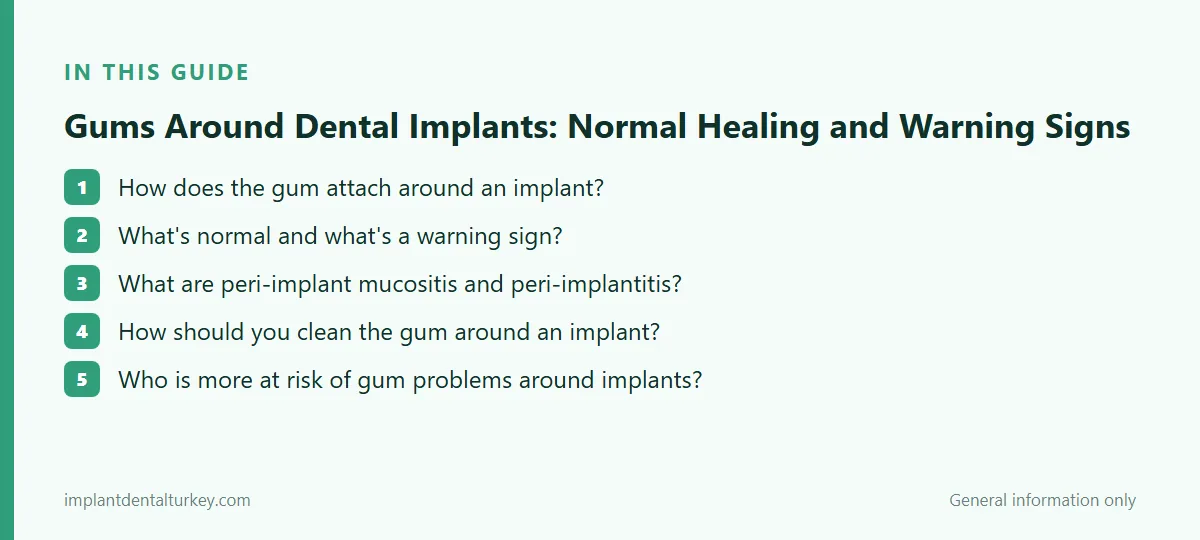
The gum surrounds the part of the implant that comes through into your mouth, and that tissue can become inflamed or infected, sometimes without any obvious symptoms. This guide explains what’s normal, what isn’t, and how to clean around implants properly.
How does the gum attach around an implant?
Cleveland Clinic explains that an implant has a threaded post in the jawbone and an abutment that screws into it and extends slightly beyond the gums, with the crown on top. The gum heals around that abutment. In a two-stage approach, Cork University Dental School and Hospital describes a second, smaller surgery after about four to six months of healing, when an extension is placed through the gum so the gum can heal around it before the crown is made.
What’s normal and what’s a warning sign?
| What you notice | What it may mean | What to do |
|---|---|---|
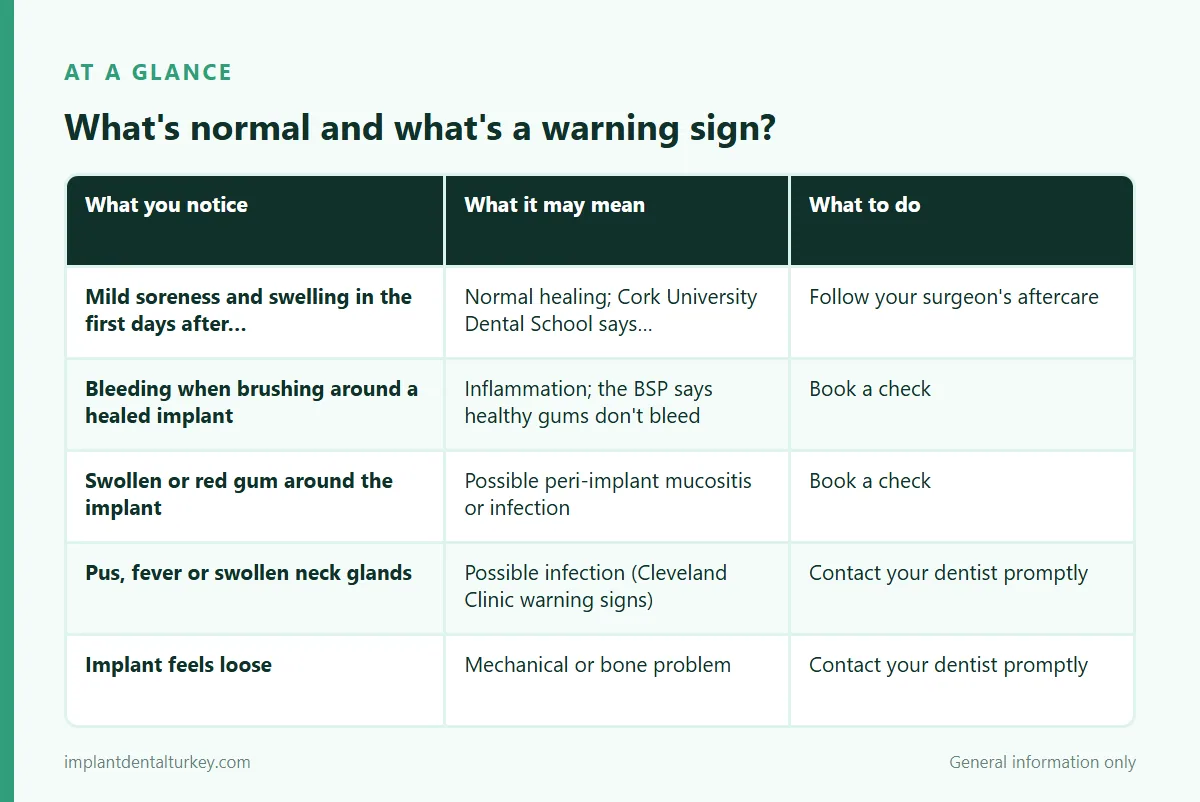
| Mild soreness and swelling in the first days after surgery | Normal healing; Cork University Dental School says it’s usually worst in the first few days | Follow your surgeon’s aftercare |
| Bleeding when brushing around a healed implant | Inflammation; the BSP says healthy gums don’t bleed | Book a check |
| Swollen or red gum around the implant | Possible peri-implant mucositis or infection | Book a check |
| Pus, fever or swollen neck glands | Possible infection (Cleveland Clinic warning signs) | Contact your dentist promptly |
| Implant feels loose | Mechanical or bone problem | Contact your dentist promptly |
What are peri-implant mucositis and peri-implantitis?
A 2025 review in Bioinformation describes peri-implant mucositis as a reversible inflammation limited to the gum around an implant, and peri-implantitis as a progressive disease that also affects the bone. Peri-implantitis usually develops from untreated mucositis. Signs include bleeding on probing, pus, deeper pockets and bone loss on X-ray, and early disease can be silent. The British Society of Periodontology explains that gum disease around implants starts with bleeding and can progress to loss of supporting bone, which could lead to losing the implant.
How should you clean the gum around an implant?
- Brush normally. The BSP says it’s safe to brush an implant just like a natural tooth, with a powered or manual brush, for two minutes twice a day.
- Use a single-tufted brush for hard-to-reach areas around the implant, as the BSP suggests.
- Clean between teeth. Interdental brushes in the right size are highly effective, according to the BSP. The Scottish Dental Clinical Effectiveness Programme (SDCEP) advises they should fit snugly.
- Be gentle with floss. SDCEP guidance says floss should not be forced below the gum margin around an implant, and patients with exposed implant threads are better served by interdental brushes.
- Ask for training if you have a bridge or denture on implants. SDCEP says these patients need personalised oral hygiene instruction.
Who is more at risk of gum problems around implants?
The BSP names a history of periodontitis and smoking as factors that increase risk. The 2025 review adds poorly controlled diabetes, poor oral hygiene, excess cement and a lack of regular professional maintenance. If any apply to you, regular maintenance visits matter even more. Our article on gum surgery in NZ explains treatment if problems develop.
How often should implants be checked?
The BSP stresses that gum disease around implants may cause no symptoms, so regular visits to your dentist, hygienist or dental therapist are important. Ask your dentist what recall interval suits your mouth. The 2025 review found that patients in long-term supportive care had lower rates and severity of peri-implantitis. In New Zealand, adults usually pay privately for this care; Health NZ notes there’s no fixed fee structure for private dentists, so it’s worth asking about fees. See our guide on the cost of a dentist visit in NZ.
Sources
- British Society of Periodontology and Implant Dentistry, Looking after your implants
- Scottish Dental Clinical Effectiveness Programme, Implant oral hygiene
- Javiya P et al., Peri-implantitis: Etiology, prevention and management strategies, Bioinformation, 2025
- Cleveland Clinic, Dental Implants
- Cork University Dental School and Hospital, Patient Information Leaflet: Implant Surgery
- Health NZ, Dental care
This article is general information and is not a substitute for advice from your own dentist.