Dental Implant Healing Abutment: What It Is and How to Care for It
The small cap that shapes your gum before the crown, and how to look after it.
Edited and fact-checked by our editorial team.

A dental implant healing abutment, sometimes called a healing cap or cuff, is a small temporary piece fitted to the top of the implant so the gum can heal around it before the permanent abutment and crown are made. Keep it clean, leave it alone, and call your dentist if it feels loose.
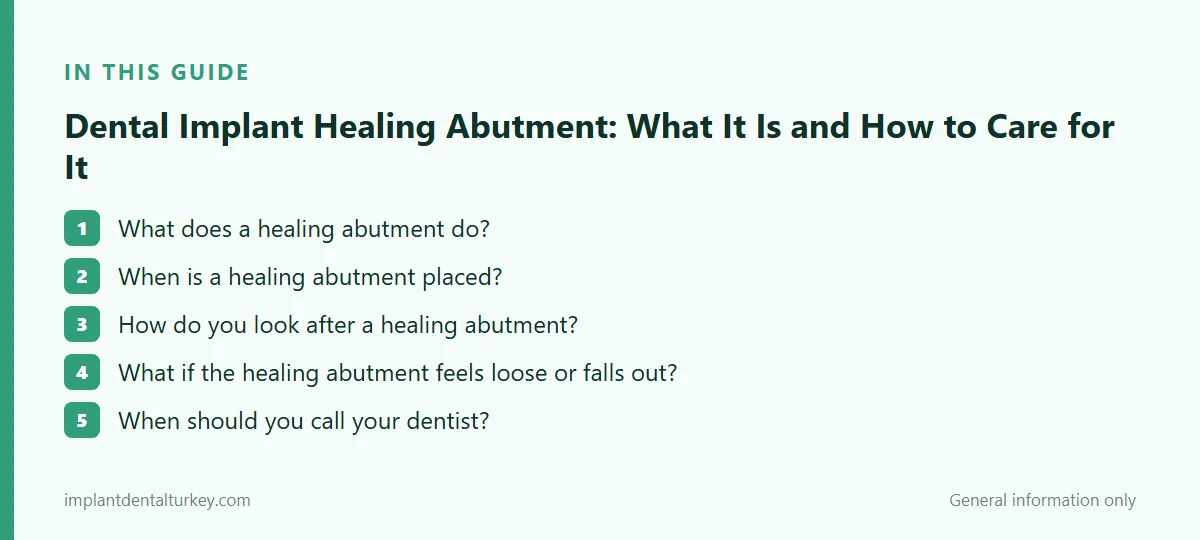
If you can see a small cap sitting in your gum after implant surgery, this is probably it. This guide explains what that piece is for, when it’s placed, how to look after it and when to call your dentist. Every treatment plan is different, so your surgeon’s instructions come first.
What does a healing abutment do?
Cleveland Clinic describes an implant as three parts: a threaded post in the jawbone, an abutment that connects to it and extends slightly beyond the gums, and the crown or other restoration on top. Before the final abutment and crown go in, the gum needs to heal into the right shape around the implant.
Colgate explains that after the implant has fused with the bone, the dentist may place a healing cap to help the gum heal, usually taking around two weeks. The cap is then removed and the abutment is fitted. Cork University Dental School and Hospital describes the same idea: after the implant has healed, a smaller second surgery places an extension that shows above the gum and lets the gum heal around it, preparing for the crown, bridge or denture.
When is a healing abutment placed?
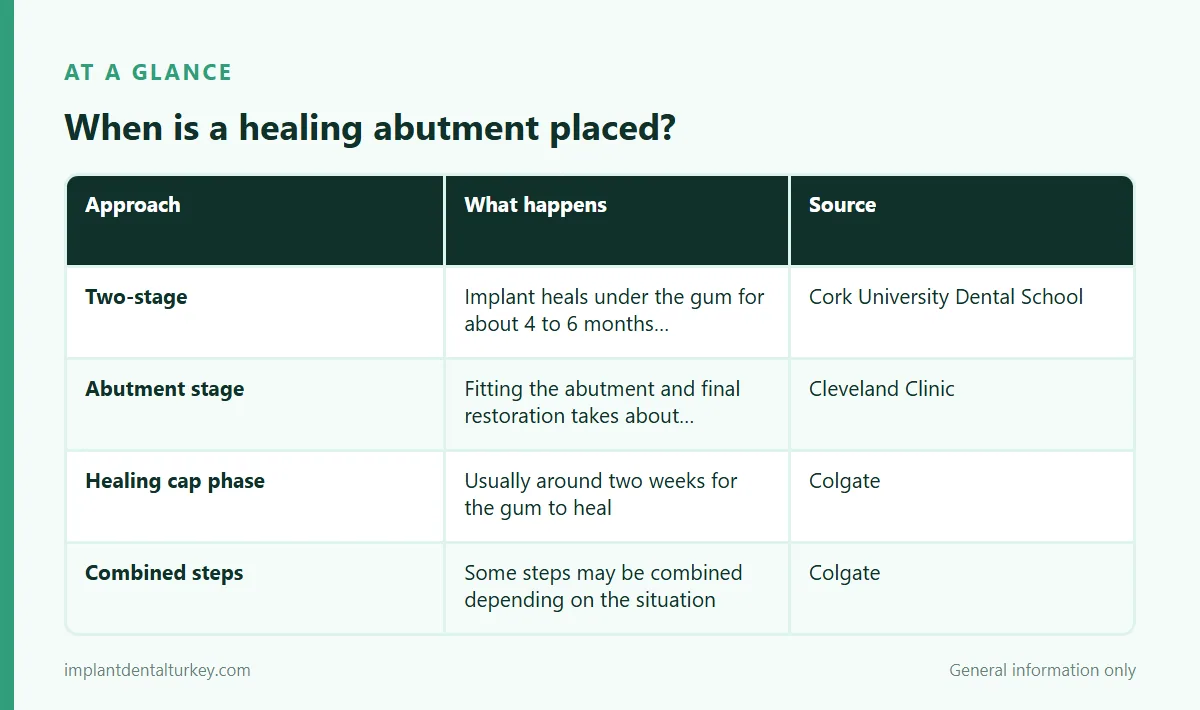
| Approach | What happens | Source |
|---|---|---|
| Two-stage | Implant heals under the gum for about 4 to 6 months, then a second minor surgery places the extension through the gum | Cork University Dental School |
| Abutment stage | Fitting the abutment and final restoration takes about an hour and may need a second minor surgery | Cleveland Clinic |
| Healing cap phase | Usually around two weeks for the gum to heal | Colgate |
| Combined steps | Some steps may be combined depending on the situation | Colgate |
Your dentist will tell you which approach applies to you. If you’re unsure whether you have a healing abutment or a final one, ask at your next visit.
How do you look after a healing abutment?
- Keep the area clean. Cork University Dental School says it’s important to keep your mouth as clean as possible for the first few weeks after surgery, brushing gently but thoroughly, and rinsing the sore area after eating with the recommended mouthwash or warm salt water from the day after surgery.
- Be gentle. The Scottish Dental Clinical Effectiveness Programme advises an effective but atraumatic cleaning technique to avoid injuring the soft tissue around implants.
- Leave it alone. Don’t try to unscrew, adjust or pick at it.
- Eat carefully. Cleveland Clinic’s oral surgery guidance favours soft foods for the first two to three days and avoiding hard, crunchy foods.
- Don’t smoke. Cleveland Clinic says smoking can disrupt healing after implant surgery.
What if the healing abutment feels loose or falls out?
Contact your dentist promptly rather than waiting for your next scheduled appointment. Cleveland Clinic lists a loose or wobbly implant among the signs to call about. A review of abutment screw loosening by Krishnan and colleagues notes that loosened screws tend to loosen further under biting loads, so earlier attention is better. If the piece comes out completely, keep it and bring it with you. Don’t try to screw it back in yourself.
When should you call your dentist?
- The healing abutment moves, rotates or comes out.
- There’s pus, worsening swelling or fever (Cleveland Clinic warning signs).
- The area keeps bleeding or the gum looks increasingly swollen.
- Pain is getting worse rather than better after the first few days.
Our implant procedure guide for New Zealand explains where this step fits, and our article on how many visits implants need covers appointment planning.
Sources
- Colgate, Single-Tooth Implants: What to Expect
- Cleveland Clinic, Dental Implants
- Cork University Dental School and Hospital, Patient Information Leaflet: Implant Surgery
- Scottish Dental Clinical Effectiveness Programme, Implant oral hygiene
- Cleveland Clinic, What to Eat After Oral Surgery
- Krishnan V et al., Management of Abutment Screw Loosening, J Indian Prosthodont Soc, 2014
This article is general information and is not a substitute for advice from your own dentist.