Why Is Smoking Bad for Dental Implants? What the Evidence Shows
Smoking, vaping and implants: the research, the reasons and practical steps to reduce risk.
Edited and fact-checked by our editorial team.

Why is smoking bad for dental implants? Because it interferes with healing and with the bone that has to grow around the implant. A large 2021 meta-analysis found implants in smokers had roughly 2.4 times the odds of failing compared with non-smokers, and smoking also raises the risk of gum disease around implants.
If you smoke and are thinking about implants, this is not a reason to give up on them, but it is a reason to plan. Below is what the research shows, why smoking causes problems, and what you can do before and after surgery to give an implant a better chance.
What does the research say about smoking and implant failure?
The clearest figures come from a systematic review and meta-analysis by Mustapha, Salame and Chrcanovic, published in Medicina in 2021. It pooled 292 publications covering 35,511 implants placed in smokers and 114,597 in non-smokers.
- Failure: implants in smokers had an odds ratio of 2.402 for failure compared with non-smokers. The authors summarise this as a 140.2% higher risk of failure.
- Upper and lower jaw: the higher failure odds held in both the maxilla (2.910) and the mandible (2.866).
- Bone loss: smokers showed more marginal bone loss around implants, with a mean difference of 0.58 mm.
- Time: the effect did not clearly fade with longer follow-up.
The authors note limits: many included studies were retrospective or small, and factors like diabetes and gum disease were not always controlled. Even so, the direction of the finding is consistent.
Why does smoking cause problems for implants?
An implant only works if the jawbone fuses to it, a process Cleveland Clinic says takes anywhere from three to nine months. Anything that slows healing or harms bone works against that process. The 2021 review links smoking’s effects to toxins that disrupt bone metabolism, new bone formation and the growth of blood vessels, and to a higher risk of peri-implantitis, the gum and bone infection around implants.
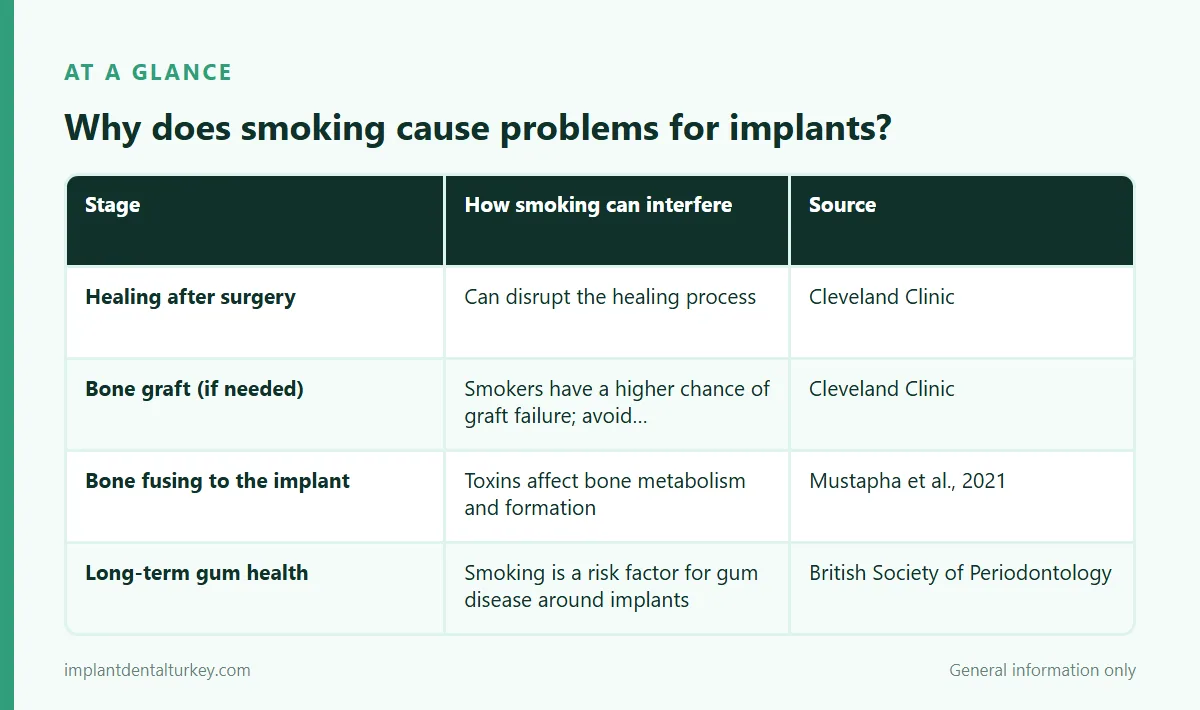
| Stage | How smoking can interfere | Source |
|---|---|---|
| Healing after surgery | Can disrupt the healing process | Cleveland Clinic |
| Bone graft (if needed) | Smokers have a higher chance of graft failure; avoid smoking during recovery | Cleveland Clinic |
| Bone fusing to the implant | Toxins affect bone metabolism and formation | Mustapha et al., 2021 |
| Long-term gum health | Smoking is a risk factor for gum disease around implants | British Society of Periodontology |
Can smokers still get dental implants?
Often, yes, but it depends on the person. Cleveland Clinic says implants “may not be a good idea” for people who smoke or vape because it can disrupt healing. Cork University Dental School and Hospital’s patient leaflet says smoking may make implants impossible for some people and that the risk of failure is higher in smokers. Your surgeon is the one to weigh your overall situation, including your gum health, bone and other medical conditions.
Be honest about how much you smoke or vape. It changes the advice you get and the risks your dentist will discuss with you.
What can you do to lower the risk?
- Talk to your dentist early about smoking or vaping, so it can be factored into planning.
- Get support to quit. In New Zealand, Quitline offers free phone, text and online help on 0800 778 778 or by texting 4006, and Health NZ says patches, gum and lozenges are free at local Stop Smoking Services.
- Avoid smoking during healing. If you need a bone graft, Cleveland Clinic advises avoiding smoking and vaping during recovery.
- Keep plaque under control. The British Society of Periodontology recommends brushing two minutes, twice daily, plus interdental brushes.
- Keep up maintenance visits. Gum disease around implants may cause no symptoms, so regular professional checks matter.
The 2021 review authors note that more research is needed on whether stopping smoking around the time of surgery changes outcomes, so treat quitting as part of overall risk reduction rather than a fix. For the wider picture of the procedure, see our guide to the dental implant procedure in New Zealand.
Does vaping count?
Cleveland Clinic groups smoking and vaping together when it says they can disrupt healing after implant surgery and after bone grafting. If you have switched to vaping, mention it to your dentist in the same way.
Sources
- Mustapha AD, Salame Z, Chrcanovic BR, Smoking and Dental Implants: A Systematic Review and Meta-Analysis, Medicina, 2021
- Cleveland Clinic, Dental Implants
- Cleveland Clinic, Dental Bone Graft
- Cork University Dental School and Hospital, Patient Information Leaflet: Implant Surgery
- British Society of Periodontology and Implant Dentistry, Looking after your implants
- Health NZ, Stopping smoking
This article is general information and is not a substitute for advice from your own dentist.