False Teeth or Dental Implants? Weighing Up the Options
How removable dentures, implants and implant-retained dentures compare day to day.
Edited and fact-checked by our editorial team.

Choosing false teeth or dental implants comes down to stability, bone health, upkeep and budget. Removable dentures rest on the gums and can slip, while implants are anchored in the jawbone and help preserve it. Implants also need surgery, healthy bone and months of healing, so they are not right for everyone.
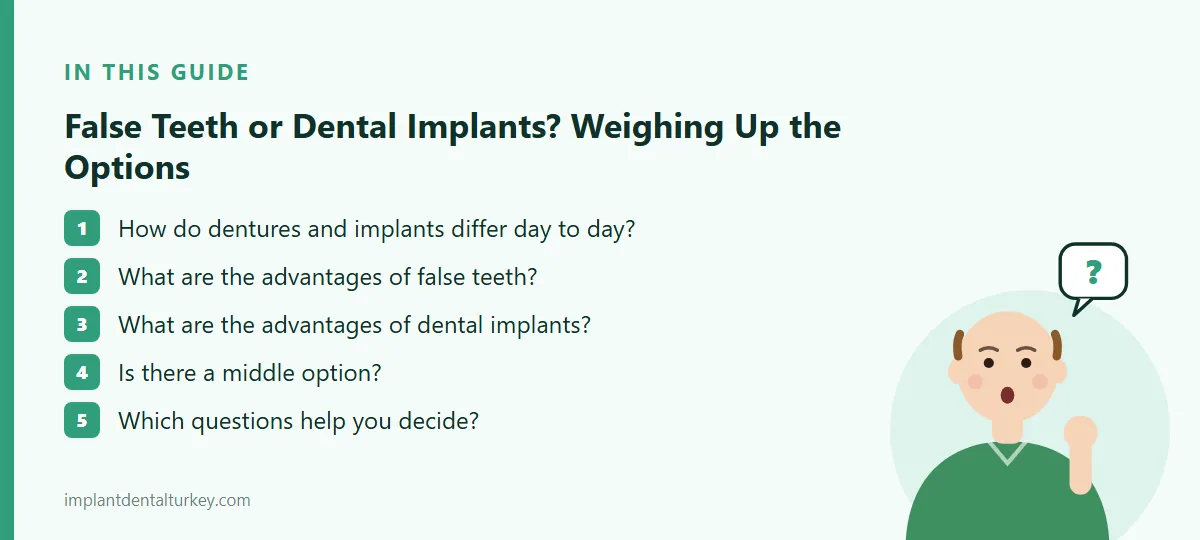
Many New Zealanders weighing up tooth replacement are not choosing between two fixed products but between several points on a spectrum: a conventional denture, a denture clipped onto a few implants, or individual implant crowns and bridges. This guide sets out how each option behaves day to day so you can have a better-informed conversation with your dental team.
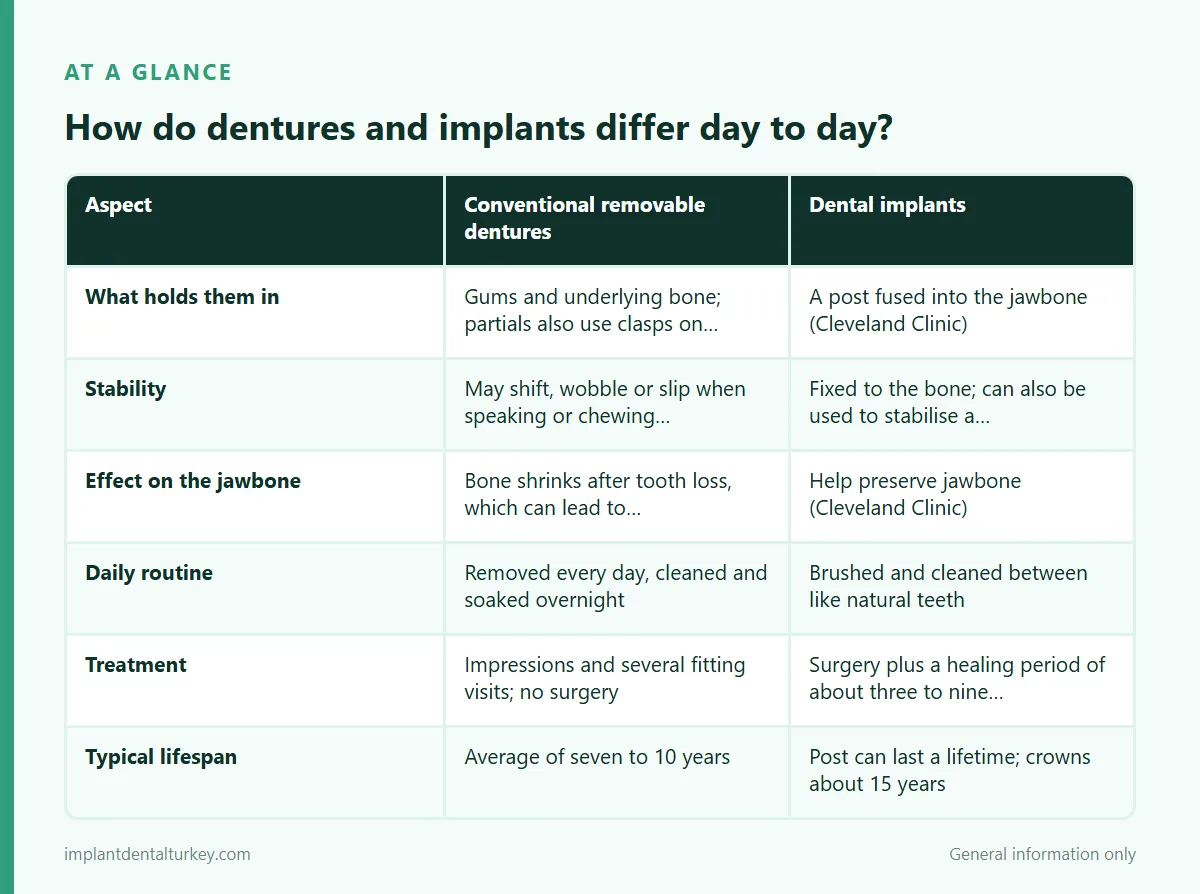
How do dentures and implants differ day to day?
| Aspect | Conventional removable dentures | Dental implants |
|---|---|---|
| What holds them in | Gums and underlying bone; partials also use clasps on remaining teeth (Cleveland Clinic) | A post fused into the jawbone (Cleveland Clinic) |
| Stability | May shift, wobble or slip when speaking or chewing (Cleveland Clinic) | Fixed to the bone; can also be used to stabilise a loose denture |
| Effect on the jawbone | Bone shrinks after tooth loss, which can lead to sunken cheeks | Help preserve jawbone (Cleveland Clinic) |
| Daily routine | Removed every day, cleaned and soaked overnight | Brushed and cleaned between like natural teeth |
| Treatment | Impressions and several fitting visits; no surgery | Surgery plus a healing period of about three to nine months |
| Typical lifespan | Average of seven to 10 years | Post can last a lifetime; crowns about 15 years |
What are the advantages of false teeth?
Dentures have real strengths that are easy to overlook. Cleveland Clinic lists improved chewing, appearance, speech and nutrition among their benefits. Conventional dentures are made from impressions and models rather than surgery, and they can be adjusted, relined or remade as your mouth changes.
In New Zealand, removable dentures are also made by clinical dental technicians, not only dentists. The Dental Council of New Zealand’s scope for clinical dental technology covers taking impressions and making, repairing and fitting complete or partial removable appliances.
The trade-offs are the daily routine and gradual changes in fit. Cleveland Clinic says adjusting to new dentures can take weeks or sometimes months, recommends taking them out for at least eight hours a day, and suggests a reline every one to two years.
What are the advantages of dental implants?
Implants do not depend on neighbouring teeth or on suction. Cleveland Clinic notes that, unlike a bridge, an implant does not involve shaving down the teeth on either side of the gap, and that implants generally last longer than traditional dentures resting on the gums. The implant post can last a lifetime with good hygiene and regular dental visits.
The limits are mainly about suitability. According to Cleveland Clinic, implant patients typically need to be 18 or older and to have finished growing, with enough healthy jawbone. Implants may not be suitable with active gum disease, extensive decay, poor oral hygiene, severe bone loss or unmanaged diabetes, and bone grafting may be needed where bone has been lost.
Is there a middle option?
Yes. Implant-retained or implant-supported dentures combine the two. Cleveland Clinic describes full-arch options supported by four to six implants, which can be fixed or removable, and notes that implants can stabilise loose dentures. In New Zealand, the Dental Council has a separate scope that allows suitably trained clinical dental technicians to design, make, repair and trial fit removable implant overdentures.
Our guides to All-on-4 implants in NZ and full mouth implant costs go further into fixed full-arch options.
Which questions help you decide?
- How many teeth are missing, and are the remaining teeth healthy enough to keep?
- Is there enough bone for implants, and would grafting be needed?
- Do you have any health conditions or habits, such as smoking, that affect healing?
- How do you feel about removing and cleaning a denture every day?
- What is the total cost now, and what maintenance should you budget for over ten years?
Only a dentist can tell you whether you are a suitable candidate for implants, Cleveland Clinic stresses. Ask for a written plan that compares options for your mouth, not just the one being recommended.
Sources
- Cleveland Clinic, Dentures
- Cleveland Clinic, Dental Implants
- Dental Council of New Zealand, Clinical dental technicians: scopes of practice
This article is general information and is not a substitute for advice from your own dentist.